
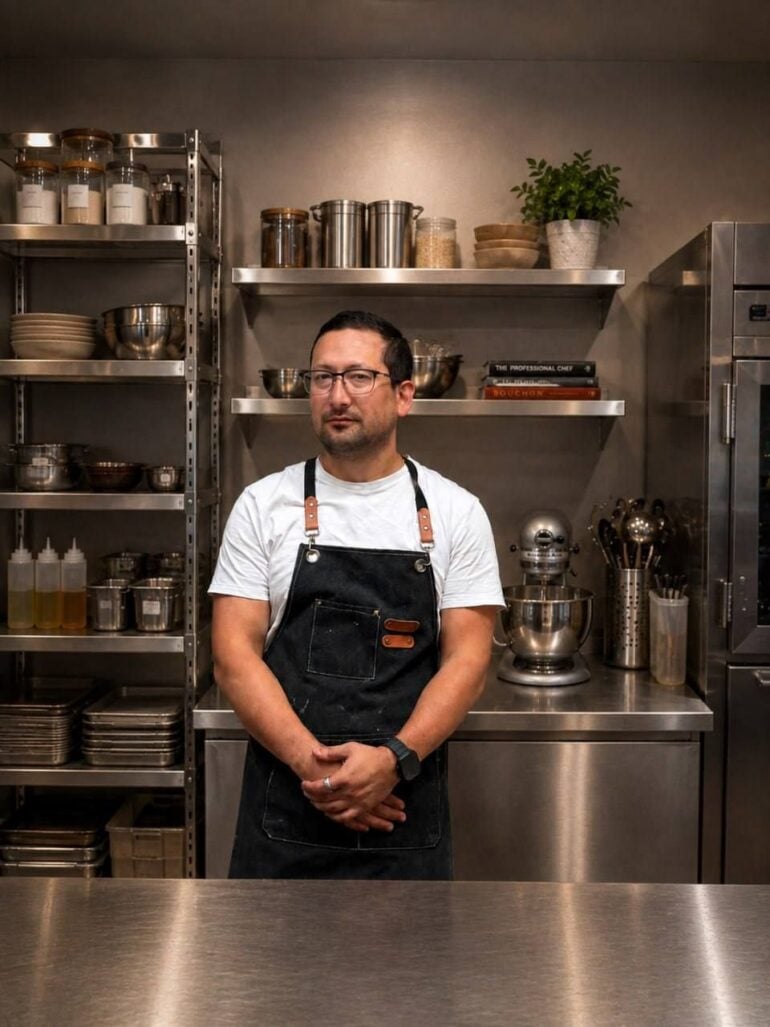
Ilia Vlasov is an expert in launching food production operations and FoodTech startups, with more than 20 years of industry experience. His career has taken him from working as a chef to owning a business that generated a 25% net profit margin. Today, he works as a private chef, creating signature menus for millionaires, while simultaneously preparing to launch his own vegan startup — a tofu-based mayonnaise business designed to compete with major players in the plant-based food market. Vlasov, a seasoned HoReCa expert, spoke with our editorial team about how to create a healthier sauce with a low production cost and bring it to the U.S. market.
Tofu-Based Mayonnaise
After studying supermarket shelves in the United States, Vlasov identified an underserved niche in the vegan sauce category — mayonnaise.
He found that many mass-market vegan mayonnaises share the same problem. To eliminate eggs while maintaining a thick consistency, major brands often rely on modified starch, xanthan gum, and formulas containing up to 70% inexpensive canola or soybean oil. As a result, the product loses much of its appeal as a “healthy” alternative.
At the same time, data from The Good Food Institute indicates that consumers have increasingly been turning away from vegan products with complicated, highly processed ingredient lists. For example, retail sales of plant-based meat in the United States have fallen by 10%, with concerns over complex formulations cited as one of the reasons.
Vlasov found his solution in tofu-based vegan mayonnaise. Tofu is a soy-based food produced by coagulating soy milk.
A Healthier Alternative
There are several reasons why a product of this kind could find demand in the U.S. market.
The first is its low calorie content. According to some studies, restaurant meals in the United States exceed recommended calorie levels in more than 90% of cases, making oversized portions one of the major contributors to obesity in the country.
Low-calorie tofu mayonnaise offers restaurants a potential solution by serving as a versatile base ingredient for chefs. Because of tofu’s neutral flavor and the naturally creamy texture of soy protein, the base can be used to create a wide range of sauces — from lighter Caesar dressings and reduced-calorie spicy sauces for poke bowls to flavorful burger sauces and vegan dips.
It is also important to note that “vegan” does not mean “only for vegans,” or people who have eliminated all animal-derived foods from their diets. The product can also appeal to people monitoring their cholesterol, those who cannot consume dairy products, and consumers with food allergies, including egg allergies.
As a result, a single universal tofu-based sauce can meet the needs of several categories of customers at once, eliminating the need for restaurant kitchens to purchase and store three or four different sauces.
More Protein
The second factor driving potential demand is the product’s high protein content.
Conventional vegan mayonnaise contains virtually no protein because it consists primarily of fat.
Vlasov’s product, by contrast, is based on tofu, which contains between 12 and 17 grams of plant protein per 100 grams. That makes it a viable alternative to animal-based protein sources.
Putting Health First
The third factor is health.
Traditional mayonnaise contains high levels of cholesterol and saturated fat and is poorly suited to people who are overweight or living with obesity — conditions that, according to the article’s cited estimates, affect roughly 40% to 70% of the U.S. population, with California being no exception.
Tofu-based mayonnaise changes that equation. It contains no animal-derived cholesterol and can reduce the calorie content of the sauce by as much as fivefold. For millions of people who need to manage their weight, a plant-based alternative can provide a way to bring favorite foods back into their diets without compromising their health or weight-management goals.
Lowering Production Costs
“There is another problem with plant-based mayonnaise and the sauces made from it: they separate almost immediately unless certain additives are used,” Ilia Vlasov explains. “So I experimented and developed a way to solve that problem.”
Vlasov addressed the separation issue by applying the physical properties of tofu itself. He identified a specific mixing speed and temperature at which the soy protein naturally present in tofu acts as a thickener, binding the mixture together.
Plant-based mayonnaise is typically produced at factories through a more complicated and expensive process. Manufacturers purchase imported dry protein isolates, mix them with water and oil, and then stabilize the mixture using modified starches and chemical gums.
Vlasov eliminated those costly components from the production chain altogether, replacing them with a single, readily available ingredient: whole soft tofu. That approach allowed him to optimize costs and reduce the expense of industrial-scale production while maintaining a cleaner ingredient profile.
From Fine Dining to Industrial FoodTech
Vlasov’s culinary background became the foundation for developing the product.
He began his career as a chef in Marriott hotels and leading restaurants, working alongside prominent Italian chefs, including Valentino Bontempi, a renowned Italian chef and specialist in dietary gastronomy, and Luigi Rossi, a well-known Italian chef and restaurateur who built his reputation working in Italy, France, Switzerland, and the United Kingdom.
What Is Driving Demand
Launching a plant-based startup specifically in California also makes economic sense.
California is unique in the scale of its supporting infrastructure. The state is home to hundreds of FoodTech startups, thousands of health-food stores and restaurants that purchase clean-label products, and even specialized hotels catering to vegans and consumers who closely monitor the quality of their diets.
Ilia Vlasov is positioning the project primarily for the B2B market. That means the sauce will be supplied directly to California cafés, restaurants, and specialty retail chains looking for a high-quality alternative to traditional sauces.
For Vlasov, launching food production in the United States is a new challenge, but one that closely aligns with his previous experience.
His background is unusual in that he is not simply a chef, but also a food-production specialist who has personally designed and launched restaurants and cafés from the ground up, built round-the-clock production facilities, and developed large-scale B2B supply networks.
He has managed major projects under demanding conditions, ranging from setting up field kitchens at construction sites to organizing food-service operations at large public events serving more than 1,000 people per shift.
Vlasov also has experience in crisis management and in building production businesses through the full operating cycle, including their subsequent successful sale. Taken together, that experience has given him a comprehensive understanding of industrial food production and the ability to adapt an artisanal technology to the requirements of American manufacturing facilities.
The entrepreneur’s startup is currently at the product-launch stage.
“I’m not developing this product for a narrow category of vegans, but for anyone who cares about the quality of the food they eat,” Ilia Vlasov says. “My goal is to offer a healthy and flavorful alternative for anyone who wants to make more thoughtful choices about their diet.”