
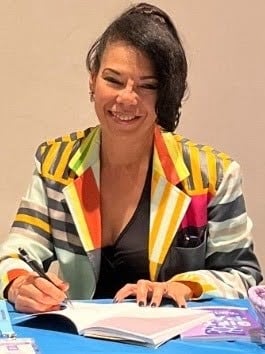
Hannah Park Lusterman stood in front of a cracked mirror in Guyana as a child, convinced that confidence lived somewhere on her face. She wasn’t alone in that belief. Millions of women have been taught the same lie: that self-worth comes from the outside in, that belonging requires looking a certain way, and that silence is safety.
It took decades, multiple corrective procedures, and a harrowing medical crisis for Lusterman to discover what confidence actually is—and where it lives. Today, she helps women undo the conditioning that keeps them small, reclaim their voices, and stop performing for acceptance. Her work challenges one of the most pervasive myths in personal development: that confidence is something you can add on, achieve, or acquire.
The Cost of Believing Confidence Lives on Your Face
Lusterman grew up in the Branch Davidian religion, where little girls were expected to be seen and not heard. She remembers darkening her eyebrows with charcoal from cooking pots, desperate to look like the girls in magazines. When her father discovered it, he made her wash it off—a small moment that felt like imprisonment.
At 16, she ran away, boarding a fishing boat with four strangers and crossing into Venezuela with one belief: that freedom was waiting somewhere beyond the life she knew. But even after she escaped, the shame followed her. She became convinced that if her nose were straight, if she looked white, she would finally feel confident and belong.
So she sought to change her face surgically. The first procedure, performed under local anesthesia, was a disaster. “I felt like a freak,” she recalls. “The tip of my nose was turned upwards.” Desperate to fix it, she returned to Caracas for a second surgery, where doctors used cartilage from her ear to reconstruct the tip. For a while, the external fix seemed to work. She looked in the mirror and thought, Great, I look both white and pretty.
But the “perfection” was a ticking time bomb. Years later, living in Texas, her body began to reject the bridge implant. A specialist informed her of a startling reality: roughly 500,000 Asian and Black women undergo similar ethnic rhinoplasty procedures every year, often without being told that these implants have a “shelf life.”
By the time she reached Florida, the bridge had protruded through her skin and become dangerously infected. A sinus specialist warned her that without immediate surgery to remove the implant, the infection could spread to her brain. Forced to undergo a third surgery—again under local anesthesia to avoid a $25,000 bill for general—she was left with visible scarring and a permanent dent in her nose.
“I always imagined the white version of me would be sure of herself,” Lusterman recalls. “But even when the surgery looked ‘good,’ my personality hadn’t changed with my new features. I looked like I belonged, but I didn’t feel like I belonged. I was still the unloved little girl who looked in the cracked mirror and saw ugliness.”
That realization became the turning point. The scars are still healing, and it may take a year to see the full extent of the damage, but the internal healing has already taken hold. Confidence was never about her looks. It was about how she saw herself. And reclaiming that inner sense of worth became the foundation for everything she does now.
Why Most Approaches to Confidence Fall Short
In her two decades of working with women, Lusterman has seen the same pattern repeat: women reaching for the next external fix—brighter lipstick, Botox, a bolder outfit, the latest trend—hoping the outside will quiet the insecurity on the inside. It offers a temporary boost, but it doesn’t stick.
She also sees women mistake courage for confidence. They push through fear, take bold action, show up, achieve—but still feel like they’re performing, proving, protecting. “Courage without inner safety can still feel like you’re running,” she explains. “Real confidence isn’t something you put on. It’s something you come home to.”
Most approaches fall short, according to Lusterman, because they treat confidence like a checklist: upgrade your look, perfect your brand, fix your mindset, take bolder action. But if a woman’s voice is still trapped under old conditioning—family rules, religious doctrine, trauma, cultural expectations—all the external upgrades in the world won’t create that deep, calm sense of self.
The Magnet to Millions Method
Lusterman developed a framework she calls the Magnet to Millions Method, built on three core steps:
- Remember your original spark. This means reconnecting with the part of yourself that existed before the shrinking, the rules, the roles, the “good girl” conditioning. What lit you up? What did you silence?
- Reclaim your voice. This is where the internal censorship gets undone—the fear of judgment, rejection, guilt, shame, people-pleasing. Women rebuild self-trust so their voice doesn’t disappear when it matters most.
- Express and own your space. This is where the work becomes lived experience. Women walk into rooms with presence. They speak clearly, ask for what they want, set boundaries, and receive without guilt. Confidence shows up in their relationships, leadership, visibility, and money.
“That’s the work I believe in,” Lusterman says. “Not fixing women, but freeing them, so they stop chasing confidence and start radiating it.”
Real Transformation, Real Ripple Effects
Lusterman works with women who have been conditioned to hide parts of themselves to be acceptable—survivors of childhood trauma, women raised in organized religion, high-achieving women who look like they have it all together but still carry anxiety, shame, or stigma around mental health. Many were taught to be “seen and not heard,” to stay nice, quiet, and grateful, even when it costs them their voice, their money, their relationships, and their joy.
One client, Victoria, grew up being told she was fat and watching her father emotionally abuse her mother, who stayed silent. Victoria learned that women belong in the kitchen, dependent on men, and that her voice wasn’t safe. Through Lusterman’s From Fear to Confidence community, Victoria confronted the old beliefs that kept her small. Today, she runs a thriving baking business in Canada, knows her worth, and uses her voice to help other women do the same.
The impact goes beyond the individual. When a woman doesn’t feel safe to use her voice, entire systems adjust to her silence—families run on over-giving and resentment, workplaces lose out on clearer communication and stronger leadership, and communities miss the contributions of women who stay small.
But when one woman reclaims her voice, it gives permission for others to do the same. Kids learn that boundaries are normal and self-respect is nonnegotiable. Teams get healthier culture and better ideas. Communities gain pattern-breakers who create, advocate, earn, and bring other women with them.
Coming Home to Yourself
Lusterman spent over 20 years searching—through prayer, books, and deep inner work—to reach the level of self-awareness she has today. And she’s still growing. The journey doesn’t end when you find yourself, she says. It begins again, braver, clearer, freer.
Today, when she looks in the mirror and meets her own brown eyes, she feels a wave of love from deep within. The scars on her nose are no longer a source of shame, but a reminder of a life reclaimed. Her prayer is simple: “Let the light that is shining within me illuminate the path for other women to see.”
The message she wants women to walk away with is this: confidence isn’t something you’re born with or something you buy. It’s something you reclaim from within. It starts the moment you stop abandoning yourself—even in tiny ways. A few minutes of silence. Breath. Meditation. Going inward.
For women still carrying old fear, trauma, or the belief that wanting more is selfish, that message feels urgent. Those stories don’t just hurt hearts—they limit lives. And when women stop waiting for permission and start coming home to themselves, everything changes.
Hannah is currently booking stages, live events, and podcast conversations where she shares this lived experience and the Magnet to Millions Method. After this experience, women will be able to speak their truth with clarity from inner power, speak more boldly in relationships and opportunities, ask for more, and receive it.
To book Hannah Park Lusterman for your next professional development event, podcast, or live event, contact:
Email: Hannahparklusterman@gmail.com Speaker Profile: https://www.terrificspeakers.com/hannah-park-lusterman Book a Call: https://calendly.com/motivatingmillions/30min
This article is published on Harcourt Health