
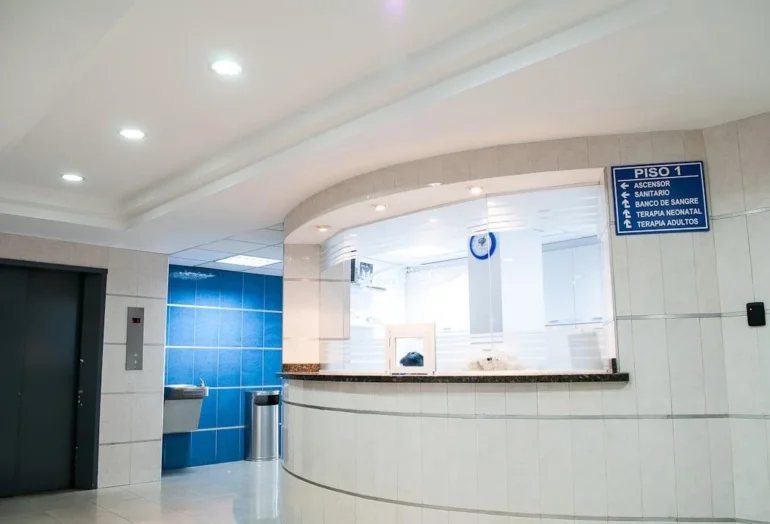
Healthcare facilities balance an obligation to remain accessible to patients and families against a duty to protect vulnerable patient populations and controlled areas. That balance makes clinical access control distinct from every other commercial environment (The Joint Commission).
Why Blanket Restriction Is Not an Option
Hospitals cannot simply restrict entry the way a data center can. Patients arrive under distress, families arrive without notice, and emergency access must remain unobstructed, which rules out uniformly tight perimeter control.
How Zoning Resolves the Conflict
Clinical facilities resolve the tension through zoning rather than perimeter hardening. Public areas remain open, while progressively tighter control applies to clinical floors, pharmacy areas, behavioral health units, and infant care areas.
How Staff Credentialing Differs in Healthcare
Clinical staff credentialing changes frequently as rotations, privileges, and contractor assignments shift. Access systems must reflect those changes quickly, since a credential that outlives its authorization is a genuine compliance exposure.
Where Integration With Clinical Systems Matters
Keeping credentials current requires connecting access control to the systems that already track staff status, and healthcare entrance deployments are built to integrate with existing credentialing and workforce systems so authorization changes propagate to entry points without manual reissuance (SES Integrators).
Why Shift Patterns Complicate Clinical Credentialing
Clinical schedules rotate across nights, weekends, and floating assignments, so a credential valid for one rotation may be inappropriate for the next. Access rules tied to scheduling data stay accurate in ways that manually maintained lists do not.
How Traveling Staff Add Administrative Load
Contract and traveling clinicians arrive for defined assignments and need access provisioned quickly and revoked reliably. Manual handling of that cycle is where expired credentials most often remain active.
Which Zones Carry the Highest Control Requirements
Four areas consistently receive the strictest access control in clinical facilities, and each protects either a vulnerable population or a controlled material.
- Infant and pediatric units with abduction prevention requirements
- Behavioral health units with elopement risk considerations
- Pharmacy and controlled substance storage areas
- Surgical suites and sterile processing environments
How Patient Privacy Rules Shape Access Records
Federal health privacy rules govern how facilities handle information identifying patients, which extends to visitor and access records tied to clinical areas (U.S. Department of Health and Human Services). Access system data in clinical settings carries handling obligations that office building data does not.
What Emergency Department Access Requires
Emergency departments face the hardest version of the problem, combining unrestricted arrival with elevated security risk. Most facilities address this with controlled transitions between the emergency waiting area and treatment areas rather than at the outer door.
Why the Interior Transition Is the Control Point
Controlling the door between waiting and treatment preserves emergency access while protecting clinical staff and patients. It places the barrier where it can function without impeding anyone arriving for care.
How Life Safety Requirements Constrain Clinical Design
Healthcare occupancies operate under specific life safety provisions governing egress and door operation (National Fire Protection Association). Access hardware in clinical settings must satisfy those provisions, which are more restrictive than requirements for business occupancies.
Why Code Compliance Requires Early Coordination
Life safety review in healthcare involves authorities and accreditation bodies with detailed expectations about door hardware. Coordinating during design avoids conflicts that are far more costly to resolve after installation.
How Infant Security Systems Interact With Access Control
Infant protection systems tie tag detection to door control at unit exits, which makes them a hybrid of access control and asset tracking. Integration quality determines whether an alarm actually secures the exit or simply announces the problem.
Why Response Procedure Completes the System
Detection hardware without a rehearsed response procedure produces an alarm and little else. The system is the hardware plus the trained response, and facilities test both together rather than separately.
What Visitor Badging Contributes
Visitor badging creates a record of who entered clinical areas and when, supporting both security review and infection control contact tracing (The Joint Commission). The record is only as good as the consistency with which badging is enforced at the point of entry.
Why Clinical Input Shapes Workable Restrictions
Access decisions in clinical settings should be reviewed with clinical staff rather than determined by security alone. Restrictions that impede care get bypassed regardless of how they were specified.
Why Rapid Replacement Matters Clinically
Clinical staff carry credentials continuously and lose them at meaningful rates. Rapid replacement matters more here than in most environments because a nurse without access cannot reach patients.
How Emergency Lockdown Requirements Apply
Clinical facilities need the ability to secure zones rapidly during a security event while preserving egress. Lockdown capability should be tested regularly rather than assumed functional.
Why Testing Reveals Configuration Gaps
Lockdown sequences frequently miss doors added after initial commissioning. Periodic testing is what surfaces those omissions before an actual event.
How Staff Duress Systems Integrate With Access
Duress alarms in clinical areas can trigger door control alongside notification, containing an incident while help arrives. That integration requires deliberate configuration rather than arriving by default.
How Wayfinding Reduces Access Problems
Visitors who cannot find the correct entrance try whichever door they encounter first, including staff-only openings. Clear exterior wayfinding prevents a substantial share of the access exceptions clinical facilities handle.
Why Signage Belongs in the Security Plan
Directing people to the right door is cheaper than controlling every door they might otherwise try. Wayfinding functions as an access control measure rather than a courtesy.
How Shift Change Affects Clinical Entrances
Hospital shift changes concentrate staff arrivals into narrow windows much like industrial facilities do. Staff entrances need sizing against that peak rather than against total headcount.
Why Staff and Public Entrances Should Separate
Mixing credentialed staff with arriving patients and families slows both populations. Separate paths let each move at its own rate and simplify the control applied to each.
What Behavioral Health Units Require Beyond Locking
Elopement risk means doors must control exit as well as entry, which inverts the usual assumption. That requirement interacts directly with life safety egress provisions and needs careful coordination.
How Delayed Egress Resolves the Conflict
Delayed egress hardware permits exit after a defined interval while alerting staff immediately. Its use is governed by code and requires approval from the authority having jurisdiction.
Why Pharmacy Access Carries Regulatory Weight
Controlled substance storage areas operate under federal recordkeeping and security requirements beyond ordinary facility policy. Access records for these spaces support compliance obligations rather than internal preference.
What Documentation Those Areas Need
Systems serving pharmacy areas must produce reliable records of who entered and when, retained for the required period. That capability should be verified at commissioning rather than assumed.
How Contractor Access Works in Occupied Clinical Space
Construction and service contractors frequently need access to areas adjacent to patient care. Time-limited credentials tied to specific zones keep that access controlled without impeding the work.
Why Infection Control Influences Hardware Choice
Touch-free operation reduces surface contact at controlled openings in clinical areas. Hardware selection in these environments accounts for cleaning protocols and contact reduction alongside security.
The Clinical Access Principle
Healthcare access control succeeds through graduated zoning rather than perimeter strength. Facilities that protect specific vulnerable areas thoroughly, while keeping public areas genuinely accessible, meet both obligations without compromising either.