
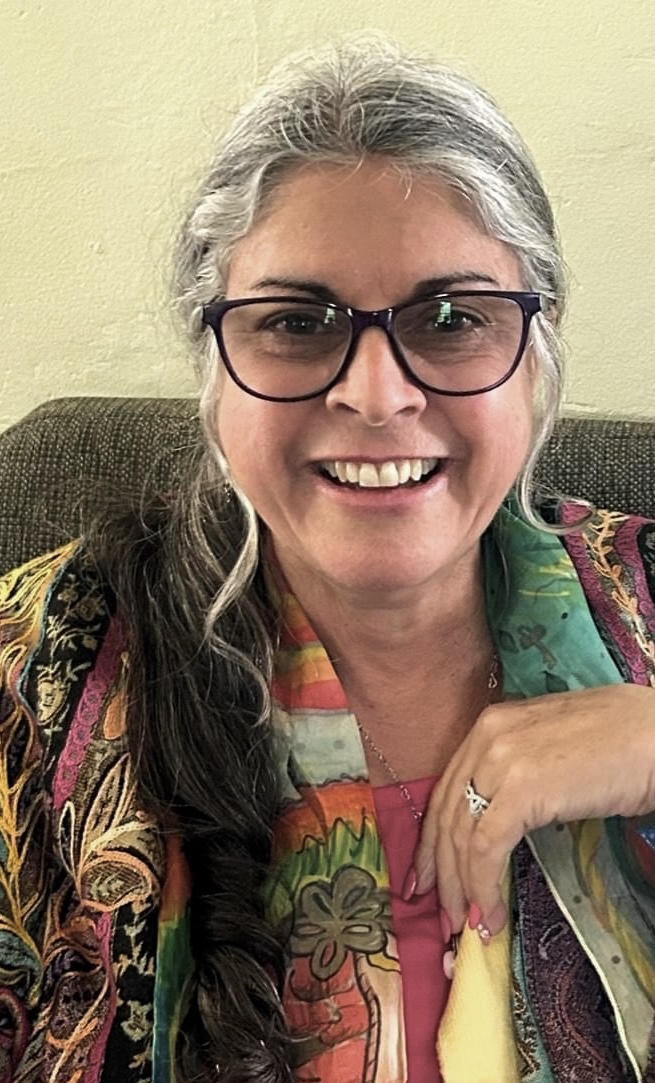
After 49 years in human services, Dr. Janet Curcio Wilson pursued a doctorate in depth psychology, weaving together ecopsychology, psychology, and quantum science. She wanted to see if there might be a way to transform our current disconnection from nature, from each other, and from ourselves into something revitalizing and sustainable for future generations. Her motivation wasn’t purely academic. Like many practitioners who have spent decades in human services, she recognized that something fundamental was missing in how we approach collective wellbeing.
Two Trees, Two Ways of Knowing
Dr. Curcio Wilson explains, “When I met Dr. Joseph Campbell in 1982 he said that a culture’s origin myth or story unfolds as that culture develops. This means a civilizations’ politics, moral values, and beliefs arise from their origin story into actual daily experiences. According to a 2012 Pew research study, approximately 57% of the world is familiar with the origin story of Genesis and the two trees in the Garden of Eden.” She decided to see if hidden within this ancient story there might be symbolism that could act as a guide leading toward a pathway of renewal. That is when she saw how humanity seems to be struggling. She identifies the problem; “Humanity seems to be dancing on the head of a pin, trying to balance good and evil.”
Then, when she recreated the two trees in acrylic painting she used a technique developed by Dr. Carl Jung, the founder of analytic psychology to analyze their symbolism. This technique is called, active imagination which is designed to make unconscious material observable and conscious. She then imagined overlapping these two trees into a third painting, which she called, The Mandorla Pathway. Together, these three images (below) make up The Genesis Triad.
This pointed toward a two-part solution—one rooted in the ancient wisdom of the Genesis story and, the other emerging from cutting-edge science.
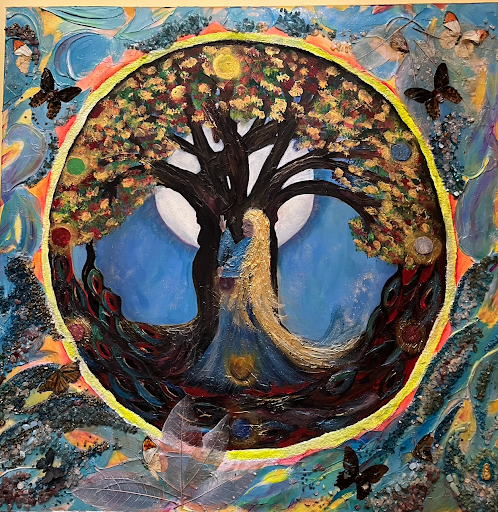
The Tree of Life, by Janet Curcio Wilson
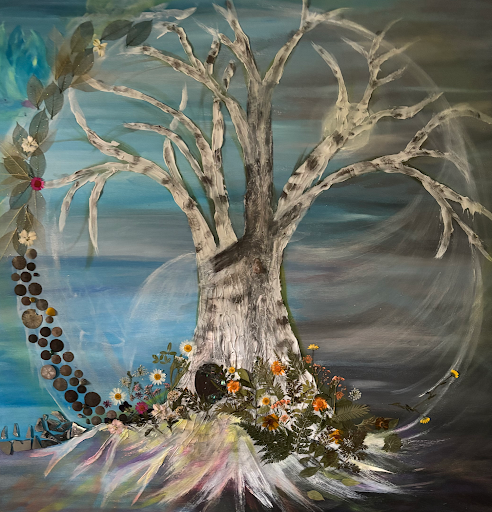
Tree of Knowledge by Janet Curcio Wilson
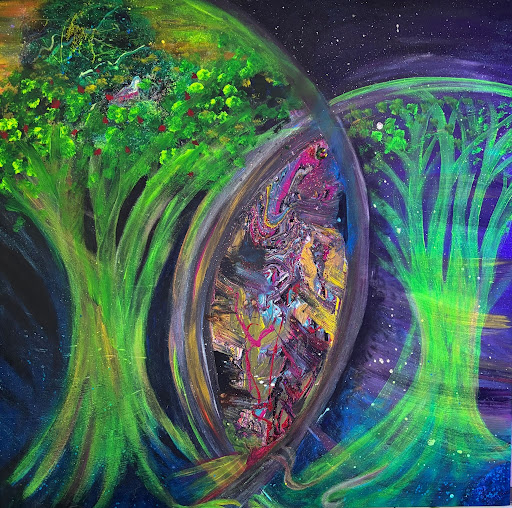
The Mandorla Pathway by Janet Curcio Wilson
By analyzing the symbolism contained within these two trees, Dr. Curcio Wilson saw how the Genesis origin story unfolded into the Westernized world we now experience as disconnected. This path of the Tree of Knowledge emphasized linear, logical, and analytical thinking. By contrast, she also saw how the global southern hemisphere pursued the Tree of Life in its emphasis on feelings, creativity, intuition, and reciprocal relationship-building. According to Dr. Curcio Wilson, we’ve become so fixated on the fruit of the first tree that we’ve neglected the second entirely.
“Tree of Knowledge thinking obsesses over what’s right and what is wrong,” she says. “We took a bite of that apple, and we’re choking on it now—emotionally, psychologically, spiritually. It’s leaving us feeling powerless.”
By contrast Dr. Curcio Wilson notes, Indigenous cultures have maintained a different relationship with a more heart-centered way of knowing. Those who “never left the garden” preserve a deep connection to nature and a more integrated way of experiencing the world. Dr. Curcio Wilson suggests that it may be time for both global hemispheres to learn from one another; where the westernized world integrates heart-centeredness and the southern hemisphere benefits from the many scientific and technological innovations of the north. This is what she calls, “The mandorla” (or middle) pathway.
It is here she points to a two-part solution—one rooted in the ancient wisdom of the Genesis story and, the other emerging from cutting-edge science.
The Potential of Collective Consciousness
To illustrate the second solution, which is gradually gaining credibility, Dr. Curcio Wilson points to a striking example from September 11, 2001. When the Twin Towers fell, researchers involved in the Global Consciousness Project observed something remarkable. Random number generators began producing patterns. Researchers suggested that this occurred due to the emotional reaction of millions of people, thereby creating a measurable shift in data.
This wasn’t an isolated incident. Quantum research has repeatedly demonstrated that human thinking, feeling, and intention appear to influence outcomes in ways that classical physics cannot fully explain. In one widely cited study, in 1999 ~4,000 people practicing group meditation in Washington, D.C. corresponded with a 23% drop in violent crime in the surrounding area. For Dr. Curcio Wilson, these findings suggest that our inner world affects our outer world far more than most people realize—and that we may be overlooking our greatest source of agency.
Toward ReGenesis
Dr. Curcio Wilson’s proposed path forward begins with what she calls “exquisite listening”—a nature therapy practice she created that fully engages the senses by cultivating positive self-talk aimed at developing a soulful and reciprocal relationship with nature. This is not about taking a casual walk in the woods. It’s about something more fundamental: reestablishing our ‘felt connection’ to the living world. She calls this process “reGenesis”—a return to the garden to learn conscious relationship-building, rather than to rely on unconscious habituation.
At the heart of her work is a conviction that runs counter to the prevailing sense of helplessness many people feel in the face of global crises. The future, Dr. Curcio Wilson argues, is not something that simply happens to us while we watch from the sidelines.
She states, “The future of humanity is something we can co-create together.”.
This isn’t magical thinking or New Age optimism divorced from reality. It’s a synthesis of psychological insight, scientific observation, and ancient Indigenous wisdom pointing toward a more integrated model of human agency—one that recognizes consciousness itself as a variable in humanity’s evolution..
For leaders, entrepreneurs, and changemakers feeling the weight of overwhelming challenges, Dr. Curcio Wilson’s message offers both responsibility and hope. If our inner state influences outcome, then the work of transformation begins not only with strategy and action, but with how we think, feel, and relate to the world around us. In a culture that prizes doing over being, her invitation is radical: that we might change the trajectory toward the Anthropocene by changing our relationships to ourselves, to nature, and to others.
References:
Hagelin, J. S., Orme-Johnson, D. W., Rainforth, M. V., Cavanaugh, K. L., Alexander, C. N., Shatkin, S. F., Davies, J. L., Hughes, A. O., & Ross, E. (1999). Effects of group practice of the Transcendental Meditation program on preventing violent crime in Washington, DC: Results of the National Demonstration Project, June–July 1993. Social Indicators Research, 47(2), 153–201. https://doi.org/10.1023/A:1006978911496.
Jung, C. G. (1969). The structure and dynamics of the psyche (R. F. C. Hull, Trans.; 2nd ed., Vol. 8). Princeton University Press. (Original work published 1916)
Pew Research Center. (2012). The global religious landscape: A report on the size and distribution of the world’s major religious groups as of 2010. Pew Research Center. https://www.pewresearch.org/religion/2012/12/18/global-religious-landscape/
This article is published on Harcourt Health