
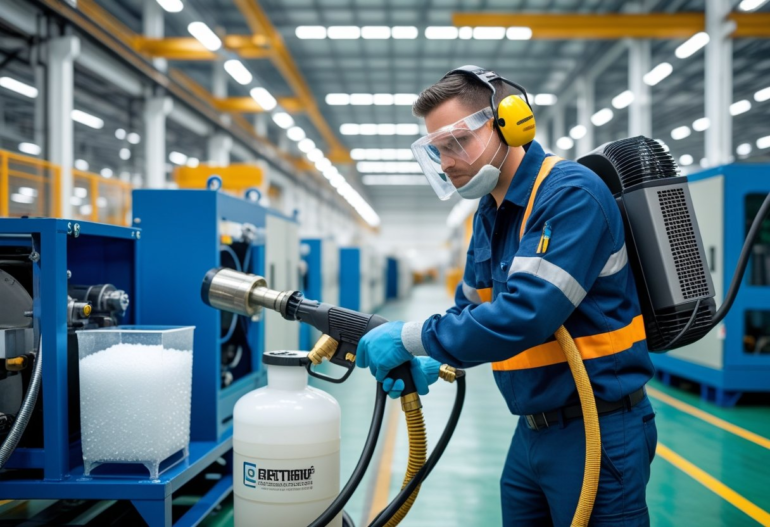
Industrial dry ice blasting plays a growing role in modern maintenance environments where residue buildup, unplanned downtime, and surface sensitivity can significantly affect production efficiency. Facilities operating in manufacturing and processing sectors often require cleaning methods that minimize moisture, reduce abrasive wear, and limit disassembly. Nu-Ice Dry Ice Blasting is an industrial dry ice blasting equipment manufacturer that designs systems for dry ice blasting industrial cleaning across a range of industrial applications. Within industrial workflows, dry ice blasting manufacturing processes use solid CO₂ pellets accelerated by compressed air to remove contaminants without secondary waste, positioning the method as an alternative to abrasive media, water-based cleaning, or chemical solvents in controlled maintenance settings.
Dry ice blasting is a cleaning method that uses solid carbon dioxide (CO₂) pellets accelerated by compressed air to remove contaminants from surfaces. The process directs dry ice particles at targeted areas, where impact and rapid temperature change assist in breaking the bond between unwanted material and the underlying substrate. Unlike liquid or abrasive media, dry ice sublimates upon contact, transitioning directly from a solid to a gas. Because the CO₂ pellets dissipate during this phase change, the method does not generate secondary blasting media waste. As outlined by Nu-Ice Dry Ice Blasting, this approach is used in industrial settings where residue removal must be completed efficiently and without introducing additional moisture or debris.
Kinetic Impact
Dry ice pellets are propelled by compressed air at controlled velocities. Upon contact with a surface, the impact energy helps dislodge contaminants such as grease, coatings, or production residues without significantly affecting the underlying material.
Thermal Shock
Because dry ice is extremely cold, contact with warmer surfaces creates a rapid temperature differential. This thermal change can cause contaminants to contract or become brittle, weakening their adhesion to the substrate.
Sublimation Expansion
When the pellets strike the surface, they convert from solid CO₂ directly into gas. This rapid expansion assists in lifting loosened contaminants away from the surface, reducing the need for additional cleanup media.
A dry ice blasting system consists of several integrated components that work together to deliver controlled cleaning performance. The air compressor supplies the compressed air required to accelerate dry ice pellets through the system. The dry ice hopper stores the pellets prior to use, maintaining a steady supply during operation. A metering system regulates the amount of dry ice introduced into the airflow, allowing technicians to adjust output according to cleaning requirements. Finally, the hose and nozzle assembly directs the pressurized mixture toward the target surface, enabling precision in confined or large-scale industrial environments. Together, these components form the foundation of an operational cleaning system.
Nu-Ice Dry Ice Blasting is a U.S.-based manufacturer of dry ice blasting systems, established in 1999. The company designs and builds its equipment in the United States, focusing on industrial applications where controlled surface cleaning is required. Its systems are used across manufacturing, restoration, and maintenance environments where dry ice blasting industrial cleaning supports operational efficiency. As an industrial dry ice blasting equipment manufacturer, Nu-Ice develops machines that utilize compressed air and solid CO₂ pellets to remove contaminants without introducing water or abrasive media. The company’s equipment lineup includes portable and stationary units designed for integration into maintenance routines, scheduled shutdowns, and in-place cleaning processes within industrial settings.
Nu-Ice dry ice blasting systems include a blasting gun assembly designed for controlled pellet delivery. The blasting gun connects to interchangeable nozzle options that allow operators to adjust the spray pattern and application focus depending on the cleaning task. Straight, angled, or specialty nozzles can be used to reach confined spaces or broader surface areas.
The equipment also incorporates an integrated moisture separator to remove water vapor from the compressed air supply before it enters the blasting system. In addition, an aftercooler helps reduce the temperature of compressed air, assisting in moisture control within the air stream. These components are part of the overall system design to support consistent pellet flow and operational stability during industrial cleaning procedures.
Nu-Ice dry ice blasting machines are designed with compact, industrial-grade construction suitable for facility environments. Typical system dimensions allow maneuverability within plant floors while maintaining durable structural frames. Units vary in weight depending on configuration, supporting portability across maintenance areas. Hopper capacity is engineered to hold a measured volume of dry ice pellets for continuous operation during cleaning cycles.
Operational requirements include a specified compressed air flow range and adjustable pressure range to accommodate different surface conditions. Systems are designed to operate within defined air consumption parameters and dry ice usage rates, enabling technicians to align output with maintenance schedules and production workflows. Technical specifications may vary by model configuration while maintaining standardized industrial operating ranges.
Preparation and Setup
Operation begins with connecting the system to an appropriate compressed air source and ensuring dry ice pellets are loaded into the hopper. Air supply connections are checked, and moisture control components such as the separator and aftercooler are verified before activation.
Safety Requirements
Operators typically use appropriate personal protective equipment, including eye and hearing protection. Ventilation is considered to manage the release of CO₂ gas during operation. Equipment inspections are performed prior to startup to confirm secure hose and nozzle connections.
Typical Workflow Steps
Once powered, the operator adjusts air pressure and pellet feed settings. The blasting gun is directed toward the target surface in controlled passes. Cleaning progresses systematically across the designated area, with periodic monitoring of pellet supply and air pressure levels.
Nu-Ice dry ice blasting equipment is used across manufacturing and production facilities where machinery, molds, conveyors, and tooling require routine maintenance. In these environments, systems are integrated into scheduled downtime or in-place cleaning procedures.
Within food processing operations, the equipment is applied to production lines, packaging machinery, and related components where dry cleaning methods are required. The absence of added water supports sanitation protocols in moisture-sensitive environments.
The technology is also used in historical restoration and on delicate surfaces, including wood, stone, and architectural elements, where controlled surface interaction is necessary. In automotive and aerospace sectors, equipment is used for cleaning engine components, composite materials, and assembly fixtures. Electrical and specialty cleaning applications include motors, control panels, and other equipment where moisture introduction is limited. Across these industries, the systems are incorporated into structured maintenance workflows.
Industrial dry ice blasting is characterized by the absence of secondary blasting media waste because dry ice pellets sublimate upon contact. The process involves non-abrasive surface interaction, as solid CO₂ pellets dissipate rather than remain as residual material. It is also a dry, chemical-free method that does not rely on water or added solvents during application.
Operational considerations include ensuring adequate ventilation due to CO₂ release and maintaining appropriate compressed air supply specifications. Facilities implementing dry ice blasting manufacturing procedures evaluate air capacity, pellet storage, and technician training as part of system integration within routine maintenance programs.
Nu-Ice dry ice blasting systems are supported by accessory components designed for varied industrial conditions. Interchangeable nozzles and hose configurations allow operators to adjust reach, spray pattern, and maneuverability depending on workspace constraints. Air supply equipment, including compatible compressors and integrated aftercoolers, supports proper compressed air conditioning prior to pellet acceleration. Moisture management components assist in maintaining consistent airflow quality. Storage considerations include proper handling of dry ice pellets to reduce sublimation prior to use. Routine equipment inspection and maintenance procedures are incorporated into facility service schedules to support reliable system operation.
Frequently Asked Questions (FAQs)
What is dry ice blasting?
Dry ice blasting is a cleaning process that uses compressed air to accelerate solid CO₂ pellets toward a surface. Upon impact, the pellets assist in loosening contaminants and then sublimate, converting directly from solid to gas without leaving secondary blasting media residue.
What types of equipment are compatible with dry ice blasting systems?
Dry ice blasting equipment operates with appropriately rated air compressors that meet specified pressure and airflow requirements. Hoses, nozzles, and moisture control components are configured to integrate with standard industrial compressed air systems.
What safety considerations apply during operation?
Operators typically use personal protective equipment such as eye and hearing protection. Adequate ventilation is required to manage CO₂ gas released during sublimation. Routine inspection of hoses, fittings, and air connections is performed before use.
What infrastructure is required to operate the system?
Operation requires a compressed air source within defined airflow and pressure ranges, electrical power where applicable, and appropriate ventilation. Facilities also plan for dry ice pellet storage to minimize premature sublimation before loading.
How does it compare to abrasive cleaning methods?
Unlike abrasive media, dry ice pellets sublimate upon impact and do not remain as residual material. The process does not introduce water or chemical solvents and is used in environments where controlled surface interaction is required.
What is the environmental impact of the process?
Dry ice used in blasting is solid carbon dioxide that transitions back into gas during use. The process does not generate secondary blasting media waste and does not rely on added chemicals or water during cleaning operations.
As industrial maintenance teams continue to refine cleaning protocols within production environments, equipment selection remains closely aligned with operational consistency, safety standards, and infrastructure compatibility. Nu-Ice Dry Ice Blasting, founded in 1999, manufactures its systems in the United States for use across manufacturing, restoration, food processing, automotive, aerospace, and specialty applications. Its equipment is designed to integrate with compressed air systems and structured maintenance workflows where controlled surface cleaning is required. By focusing on system configuration, airflow management, and technician-operated processes, facilities incorporate dry ice blasting into scheduled service intervals and in-place cleaning routines. In these settings, equipment performance is evaluated as part of broader maintenance planning, compliance considerations, and operational continuity strategies across industrial environments.