
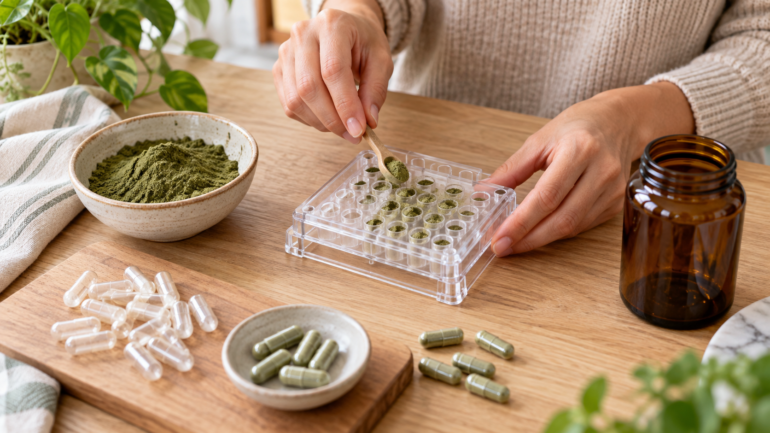
More people are taking their supplement routine into their own hands, literally. Whether it’s a specific herbal blend that’s hard to find pre-made, a way to cut out fillers and additives, or simply a way to save money on capsules bought at retail markup, making your own capsules at home has become a practical option rather than a niche hobby. It’s a skill that takes almost no time to learn and pays off every time you restock your supplement shelf.
Why Make Your Own Capsules
Store-bought supplements often come with binders, anti-caking agents, or fillers you didn’t ask for. When you make your own, you control exactly what goes into each dose, down to the ingredient and the amount. It also opens the door to combining herbs or powders in ratios that simply aren’t sold commercially, whether that’s a personalized blend recommended by a practitioner or a mix you’ve developed through your own trial and error.
Cost is another factor. Buying raw herbal powders in bulk and encapsulating them yourself is typically far cheaper per dose than buying the same ingredient pre-encapsulated, especially for anyone taking a supplement daily over the long term. A pound of bulk powder that costs a fraction of what the equivalent amount of pre-made capsules would run can often be turned into hundreds of doses over a single afternoon.
There’s also a freshness argument. Pre-made supplements can sit on a shelf or in a warehouse for months before they reach you. When you encapsulate your own, you’re working with powder you sourced and stored yourself, and you can make smaller batches more often instead of buying in bulk and hoping the product stays potent until you finish the bottle.
What You’ll Need
Getting started doesn’t require much:
- Empty capsules in your preferred size (00 and 0 are the most common for adults, with smaller sizes like 1 or 2 available for lower doses or for anyone who has trouble swallowing larger capsules)
- Your powdered ingredient, whether that’s a single herb, a blend, or a nutritional powder
- A way to fill the capsules, ranging from a small hand spoon for occasional use to a dedicated filling tray for anyone doing this regularly
- A kitchen scale, ideally one that measures in milligrams, if you want to verify dosing accuracy rather than relying on capsule size alone
Capsules themselves come in two main materials: gelatin, which is the traditional option and dissolves quickly, and HPMC (hydroxypropyl methylcellulose), a plant-based alternative suitable for vegetarians and vegans. Both work the same way mechanically, so the choice mostly comes down to dietary preference.
The Basic Process
- Prepare your powder. Make sure whatever you’re encapsulating is finely and evenly ground. Clumps or uneven particle sizes lead to inconsistent doses from capsule to capsule, and a powder that’s too coarse may not settle into the capsule body properly.
- Separate your capsule halves. Empty capsules come in two pieces, a longer body and a shorter cap, that need to be pulled apart before filling.
- Fill the capsule bodies. This is where technique matters most. Filling by hand with a small scoop works fine for a handful of capsules, but it’s slow and makes it harder to keep doses consistent. For anyone making capsules regularly, a capsule filling machine holds a full tray of empty capsule bodies upright and lets you spread your powder across all of them at once, tamping it down evenly before capping. It turns what would be a tedious one-at-a-time process into a batch job that takes a few minutes instead of an hour.
- Cap and finish. Once filled, press the caps back onto the bodies. A quality machine will also have a mechanism to seat the caps evenly across the whole tray at once, so you’re not pressing each one down individually by hand.
- Store properly. Keep finished capsules in an airtight container away from heat, light, and moisture to preserve potency. Adding a small food-safe desiccant packet can help extend shelf life further, particularly for capsules made with moisture-sensitive powders.
Getting Consistent Doses
The biggest challenge with DIY capsules isn’t the concept, it’s consistency. Filling capsules by hand often means the tenth capsule in a batch has noticeably more or less powder than the first, especially as your hand tires or your attention drifts. A capsule filling machine solves this by filling an entire tray of capsules at the same time, which keeps the fill level even across the whole batch rather than relying on a steady hand for each individual capsule.
For anyone making capsules more than a few times a month, that consistency difference alone tends to be worth the upfront investment in equipment. It also cuts down significantly on the time spent per batch, since you’re filling dozens of capsules in one pass instead of one at a time. Many home users find that what used to take the better part of an hour by hand can be done in ten or fifteen minutes with a tray-based machine.
Common Mistakes to Avoid
A few missteps tend to trip up beginners. Overfilling capsules can make them difficult to close properly, leading to caps that pop off in storage. Underfilling, on the other hand, means you’re not getting a consistent dose and may need to take more capsules than expected to hit your target amount. It’s also easy to overlook how different powders settle differently. A light, fluffy powder will fill differently than a dense, fine one, so it’s worth doing a small test batch any time you switch ingredients to get a feel for how much powder a given capsule size actually holds.
Cross-contamination is another consideration if you’re making capsules with multiple different ingredients. Cleaning your tools and equipment thoroughly between batches, especially if you or someone in your household has allergies or sensitivities, helps avoid unintended mixing.
Getting Started
If you’re new to this, start small. Pick one ingredient you already use regularly, source a quality powdered form of it, and try a small batch of capsules by hand before investing in equipment. Pay attention to how many capsules a given amount of powder produces, and adjust your grind or fill technique as needed. Once you’ve got a feel for the process and decide it’s worth doing regularly, upgrading your tools is the natural next step toward making it faster, more consistent, and less of a chore every time you need to restock.