
Historical Foundations of Global Health
 The landscape of healthcare is evolving faster than ever before. We are witnessing a monumental shift, driven by incredible medical and wellness advancements that are transforming patient care globally. From surgical procedures to the integration of cutting-edge technologies, these innovations promise a healthier, more personalized future for all.
We will take a closer look at some of these remarkable breakthroughs. We’ll explore how everything from advanced research insights and life-saving therapies to the growing field of non-invasive aesthetic advancements is reshaping how we approach health and wellness. Join us as we uncover the innovations making a real difference in patient lives, from the operating room to daily self-care.
To truly appreciate the rapid pace of modern medical and wellness advancements, acknowledge the historical breakthroughs that laid the groundwork for today’s innovations. These foundational discoveries transformed human health, significantly contributing to the near tripling of global life expectancy from just 28.5 years in 1800 to 72.6 years in 2019.
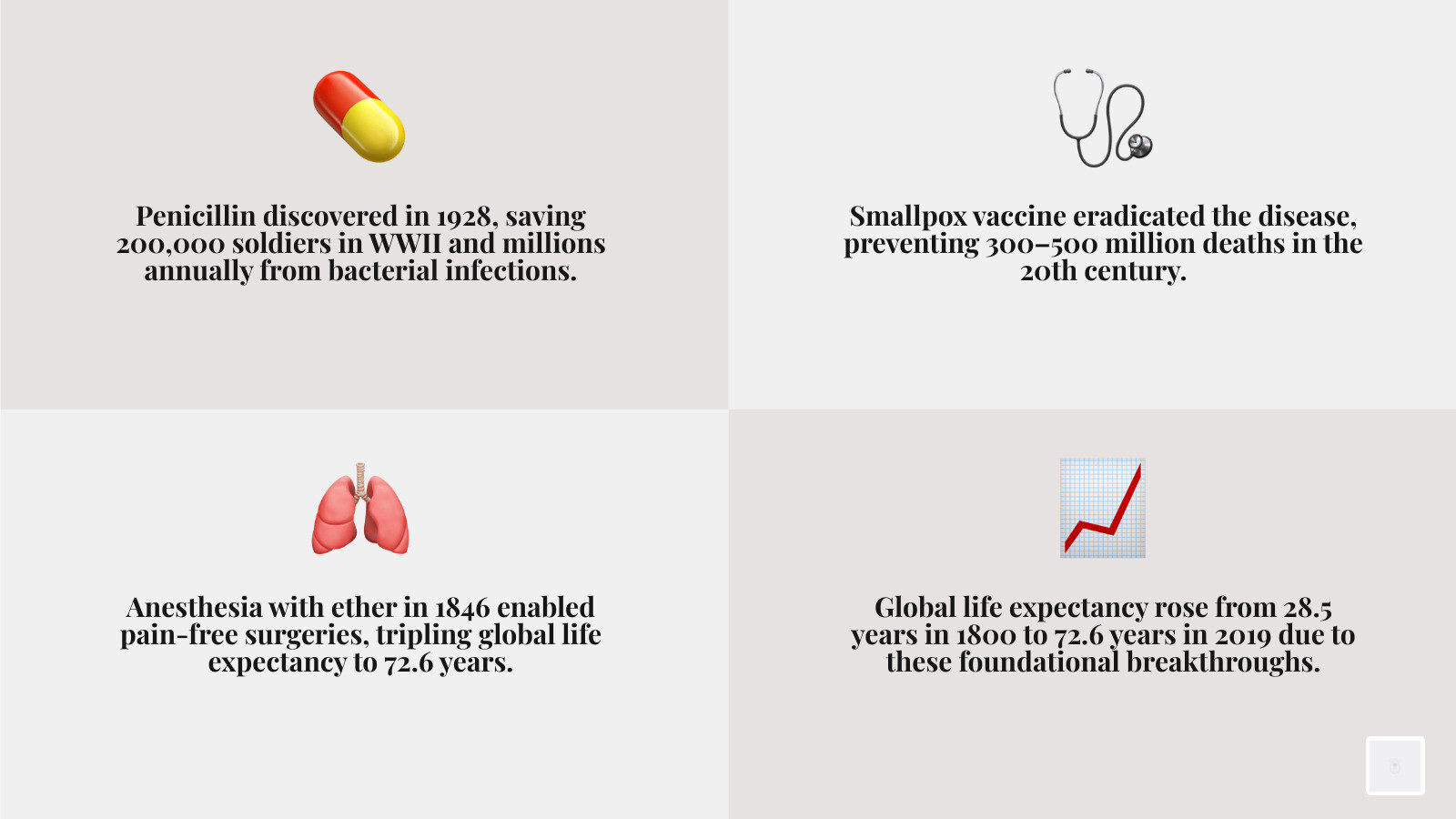
One of the most profound shifts came with the discovery of antibiotics. Alexander Fleming’s accidental discovery of penicillin in 1928, followed by its isolation, ushered in an era where bacterial infections, once death sentences, became treatable. These “miracle drugs” saved countless lives, notably an estimated 200,000 soldiers during World War II from infected wounds, and continue to save millions annually, making complex surgeries and chemotherapy far safer.
Equally transformative were vaccines. Edward Jenner’s pioneering work with smallpox in 1776 led to the eradication of this deadly disease, preventing an estimated 300–500 million deaths in the 20th century alone. Today, vaccines for numerous serious illnesses, from tetanus to HPV, prevent 4–5 million deaths each year, demonstrating their unparalleled impact on public health.
The advent of anesthesia in the mid-1800s, pioneered by figures like William TG Morton, revolutionized surgery. Before ether, surgical procedures were limited by the excruciating pain patients endured. Modern anesthesia techniques have since evolved, ensuring patient comfort and safety during increasingly complex operations.
The understanding of germ theory, largely attributed to Louis Pasteur, paved the way for antiseptics. Joseph Lister’s application of carbolic acid to surgical wounds dramatically reduced post-operative infection rates, dropping his surgical patient mortality from 46% to 15% in just a few years. This laid the foundation for modern sterile surgical practices.
Era Surgical Mortality Rate (Approx.) Key Intervention Impact Pre-Lister 40-50% None / Basic hygiene High infection rates, limited complex surgery Post-Lister 15% (Lister’s initial results) Antiseptic techniques (Carbolic acid) Significant reduction in post-op infections Modern <1% (for many procedures) Aseptic techniques, antibiotics Highly safe, complex surgeries commonplace X-rays and medical imaging provided unprecedented non-invasive views inside the human body. From Wilhelm Rontgen’s discovery in 1895 to today’s advanced CT and MRI scans, these technologies are now used in over 3.6 billion diagnostic procedures annually worldwide, critical for early detection of conditions like cancer, fractures, and internal bleeding.
Organ transplantation, beginning with the first successful kidney transplant by Joseph Murray in 1954, offered new hope for end-stage organ failure. With over 1 million transplants completed in the U.S. by September 2022 and more than 40,000 performed annually, these procedures extend and improve countless lives.
The discovery of insulin in 1921 by Banting, Best, and Macleod transformed Type 1 Diabetes from a fatal diagnosis into a manageable condition, saving millions daily. Similarly, the unraveling of the DNA helix by Watson, Crick, and Franklin, followed by the mapping of the human genome, unlocked the secrets of life itself. The cost of sequencing a whole genome plummeted from $2.7 billion in 2003 to under $1,000 by 2022, making personalized medicine increasingly accessible.
Finally, advancements in heart surgery, notably Dr. Rene Favaloro’s pioneering coronary artery bypass graft (CABG) in 1967, have drastically improved outcomes for cardiovascular disease. Interventions like CABG have contributed to a significant drop in the heart attack death rate in the U.S., from 87 per 100,000 in 1999 to 38 per 100,000 in 2020. These historical medical and wellness advancements underscore humanity’s relentless pursuit of better health.
The Evolution of Medical and Wellness Advancements in Modern Healthcare
Today, the pace of innovation continues to accelerate, with breakthroughs emerging from leading research institutions like the National Institutes of Health (NIH). The NIH’s 2025 research highlights reveal a landscape rich with human health advances, promising medical findings, and basic research insights that are poised to redefine patient care.

One of the most awe-inspiring developments is in Brain-Computer Interfaces (BCIs) for speech restoration. Imagine losing the ability to speak due to a condition like ALS, then regaining your voice through technology. This became a reality for Casey Harrell, who, through a BCI, could communicate 125,000 words with an astounding 97.5% accuracy. This transformative technology, detailed in a 2024 paper, represents a monumental leap over prior studies and offers profound hope for those living with severe communication impairments.
In a remarkable feat of surgical innovation, the world witnessed the first living mitral valve replacement in a pediatric patient. This groundbreaking procedure, often performed as part of a “domino surgery,” allows a child’s own living valve to grow with them, preventing the need for multiple, high-risk replacement surgeries as they age.
NYU Langone also made headlines with the world’s first whole-eye and partial-face transplant. While the transplanted eye did not restore vision, its remarkable recovery and viability a year post-surgery mark a significant step towards future vision restoration efforts. The ability to maintain the eye’s healthy retina, blood flow, and shape after such a complex procedure, as described in a 2024 JAMA Network article, is a testament to the dedication of over 140 medical professionals involved. This success has spurred a new, national effort focused on achieving vision-restoring whole-eye transplants.
Addressing a common challenge in emergency medicine, the new neffy nasal spray offers a needle-free alternative for treating anaphylaxis. This innovation is particularly significant given that fewer than half of patients at risk for severe allergic reactions consistently carry traditional epinephrine auto-injectors, often due to needle phobia—a concern for 20-30% of young adults. Neffy’s ease of use, even for children as young as 10, and its ability to achieve equivalent bloodstream concentrations to injections, even with nasal congestion, could dramatically improve adherence and outcomes.
As we navigate these complex and rapidly evolving medical landscapes, it’s crucial to ensure that patient rights and safety remain paramount. Organizations like the NIH, through policies such as the No Fear Act Privacy Policy, work to uphold these standards in research and development.
Breakthrough Surgeries and Medical and Wellness Advancements
The realm of surgery has always pushed the boundaries of what’s possible, and recent years have brought truly life-changing procedures. The living mitral valve replacement, for instance, is not just a technical triumph but a testament to personalized care, particularly for young patients. This innovative approach, sometimes part of a larger “domino surgery,” allows a child’s own valve to be transplanted, then grow naturally, avoiding the need for repeated, risky surgeries as they develop. You can see the incredible impact of such procedures in a dramatic video showcasing groundbreaking heart surgeries.
Beyond the heart, the brain-computer interface (BCI) field is rapidly advancing. Initiatives like Brain Gate are at the forefront of coordinating BCI research across multiple institutions. Companies like Synchron are achieving more solid results with their BCI implants, which can be inserted via the jugular vein, avoiding open-brain surgery. While Elon Musk’s Neuralink garners significant media attention, other companies are making steady progress, with implants showing “more or less very stable” performance. The potential is immense: a paralyzed man, for example, made headlines when he was able to move all four of his limbs with the help of a ‘mind-reading’ exoskeleton, demonstrating the power of various neuroproteins to restore function.
The world’s first whole-eye and partial-face transplant at NYU Langone represents another pinnacle of surgical achievement. The patient, who suffered severe injuries from an electrical accident, regained his ability to eat, smell, and speak. While the transplanted eye did not restore sight, its viability and health a year later are a critical step toward future vision restoration. As the patient himself, James, said, “I’m pretty much back to being a normal guy, doing normal things,” highlighting the profound impact of these procedures on quality of life. This complex surgery, involving over 140 medical professionals, was detailed in a 2024 JAMA Network article. NYU Langone is now part of a new, national effort to make vision-restoring whole-eye transplants a reality.
The Role of AI in Scaling Medical and Wellness Advancements
Artificial intelligence (AI) is no longer a futuristic concept but a present-day reality rapidly transforming healthcare. Its adoption among physicians surged by 78% year over year, with 66% of U.S. physicians now using AI tools in their clinical practice. Health systems are also embracing AI, with 88% using it internally, though only 18% have mature governance frameworks in place.
AI’s role is evolving from mere navigation to active clinical decision-making. Agentic AI is increasingly capable of handling tasks like triage, preparing care plans, assisting with test ordering, and even providing prescribing support. This shift promises to significantly reduce the administrative burden on healthcare professionals, allowing them to dedicate more time to direct patient care.
In specialized fields like radiology, AI is proving to be a game-changer. By assisting radiologists in analyzing complex images, AI can enhance diagnostic accuracy and speed, contributing to the early detection of critical conditions such as cancer, fractures, and internal bleeding. For those interested in how this technology is being applied in practice, exploring resources on AI-powered radiology expertise can provide valuable insights into its current capabilities and future potential. The seamless integration of AI into the diagnostic and treatment process is making a profound impact on patient outcomes.
Digital Transformation: AI, Teleradiology, and Remote Monitoring
The digital revolution is reshaping how healthcare is delivered, making it more accessible, personalized, and proactive. The American Association of Nurse Practitioners (AANP) identifies several key trends for 2026, many of which hinge on digital technologies.
Remote monitoring and wearables are becoming mainstream tools for chronic condition management. Devices that track vital signs, activity levels, and sleep patterns empower patients to take a more active role in their health, while providing clinicians with continuous, real-time data. This allows for earlier detection of health changes and proactive interventions, particularly beneficial for healthy aging and managing conditions outside traditional clinical settings. With over 461,000 licensed nurse practitioners nationwide, NPs are uniquely positioned to integrate these technologies into patient-centered care plans, translating innovation into improved health outcomes.
Beyond monitoring, mixed reality is revolutionizing medical education and training. Tools like the Microsoft HoloLens project interactive 3D anatomical models, allowing medical students to study the human body in full size and detail without cadavers. Universities like Case Western and NYU School of Medicine are already leveraging this immersive technology to enhance understanding and surgical planning.
The future of health monitoring also includes digital tattoos. These flexible, electronic patches, often made with graphene or gold nanorods, can be applied to the skin for days or weeks. They non-invasively monitor vital signs and transmit data to connected devices, offering a discreet and continuous health overview. Companies like MC10 are developing innovative BioStampRC Sensors that exemplify this technology.
Our voices, too, are becoming diagnostic tools. Vocal biomarkers are gaining recognition for revealing insights into health and detecting serious diseases. Vocalis Health has worked with Mayo Clinic to develop voice-based tools for patient health monitoring, while Sonde Health Inc. focuses on a technology platform for monitoring and diagnosing mental and physical medical conditions. Even cough analysis, with apps like CoughTracker, CoughPro, Swasaa, and Raisonance, is providing detailed insights into respiratory health.
As we embrace this digital transformation, ensuring the security and privacy of patient data is paramount. The Department of Health and Human Services (HHS) emphasizes this through initiatives like its HHS Vulnerability Disclosure policy, highlighting the ongoing commitment to protecting sensitive health information in an increasingly connected world.
Personalized Medicine and the Future of Wellness
Personalized medicine, tailoring treatments to an individual’s unique genetic makeup, environment, and lifestyle, is at the forefront of medical and wellness advancements. This approach leverages precision health insights derived from genetics and biomarkers to create highly effective and individualized care plans.
One exciting frontier is 3D-printed drugs. This technology allows for the creation of medications with customized dosages, shapes (like dinosaur pills for children), and release profiles, potentially improving patient adherence and efficacy. The FDA approved the first 3D-printed epilepsy drug, Spritam, in 2015, and companies like FabRx are now conducting the first pediatric clinical trials of 3D-printed medicines in Europe.
Pharmacological innovations continue to impress, with GLP-1 medications leading the charge. Initially for diabetes, these drugs are now widely used for weight loss and addressing metabolic health, cardiovascular risk, and even sleep apnea. Their adoption is accelerating rapidly, with 1 in 8 adults in the U.S. taking GLP-1 drugs for various conditions as of November 2025.
Beyond treating illness, the emerging field of longevity medicine focuses on extending not just lifespan but “health span” – the number of years lived in good health. This rapidly evolving area, which could add an estimated $38 trillion to the global economy for each additional year of healthy life, includes cutting-edge therapies like epigenetic reprogramming. Life Biosciences’ ER-100, a partial epigenetic reprogramming gene therapy for eye disease, is the first therapy directed at reversing aging diseases via cellular rejuvenation to enter human clinical trials.
In neurological care, adaptive deep brain stimulation (aDBS) represents a significant leap for Parkinson’s disease treatment. Unlike traditional DBS, aDBS systems like Medtronic’s BrainSense Adaptive automatically adjust stimulation based on real-time brain signals. This personalized approach, which received FDA approval, promises more effective symptom management and reduced side effects.
The pursuit of wellness also extends to non-invasive aesthetic advancements. These innovations focus on improving quality of life and self-perception without surgical intervention, contributing to overall well-being and healthy aging. From advanced skincare technologies to body contouring treatments, these options offer personalized solutions for individuals seeking to enhance their appearance and confidence. To explore some of the cutting-edge options available, you might find valuable information on Non-invasive aesthetic advancements.
Healthy aging is a holistic concept, encompassing not only medical treatments but also lifestyle interventions and supportive care. This includes addressing specific needs such as menopause care, which is critical given that 20% of U.S. working women are in some stage of menopause. Similarly, fertility benefits are a growing priority, with 70% of millennials experiencing fertility challenges willing to change jobs for better coverage.
Even our food sources are undergoing a revolution with artificial food. Lab-grown meat from companies like Mosa Meat, cultivated alternatives for pork fat from Hoxton Farms, and precision fermentation products like Cell4Food’s octopus replacement or Onego Bio’s ovalbumin are poised to reshape our diets and address global food security. Standing Ovation is even producing caseins for animal-free cheese.
The Office of Inspector General plays a vital role in overseeing these advancements, ensuring integrity and accountability in healthcare programs funded by the Office of Inspector General.
Frequently Asked Questions and Future Implications
The rapid evolution of medical and wellness advancements raises important questions about their impact and future direction.
What are the most significant medical and wellness advancements for 2026?
For 2026, we anticipate several advancements to significantly impact patient care. These include the widespread adoption of remote monitoring and wearables for proactive health management, further integration of AI into diagnostics and administrative tasks, and increasingly personalized care approaches driven by genetic insights. The focus on healthy aging will intensify, supported by innovations in longevity medicine and employer-based health initiatives. The continued rise of GLP-1 adoption for various conditions will also be a major factor. With healthcare expenditures projected to rise another 7.1% in 2025, these innovations are crucial for managing costs while improving outcomes. For broader insights into health and human services, the Department of Health and Human Services offers a wealth of information.
How do new technologies like neffy and 3D-printed drugs improve patient adherence?
New technologies are directly addressing barriers to patient adherence. Neffy nasal spray tackles needle phobia, a significant reason why many individuals at risk for anaphylaxis fail to carry or use their EpiPens. Its ease of use, even for children as young as 10, makes it a more accessible and less intimidating option during emergencies. Similarly, 3D-printed drugs offer unprecedented personalization. By allowing medications to be tailored in shape (e.g., dinosaur pills for kids), dosage, and dissolution speed, they can make taking medicine a more palatable and effective experience, especially for pediatric patients or those with complex regimens. For more government information and services related to health, you can visit USA.gov.
What are the ethical considerations for emerging medical and wellness advancements?
As medical and wellness innovations accelerate, so do the ethical questions surround them. AI governance is critical to ensure that AI tools are safe, unbiased, and used responsibly, particularly as agentic AI moves into clinical decision-making. Concerns about data privacy are paramount with the proliferation of wearables, digital tattoos, and vocal biomarkers, requiring robust protections against misuse. The gamification of health insurance, while potentially motivating, raises questions about fairness, potential premium hikes based on health data, and the specter of “Dr. Big Brother” surveillance. The notion of “recreational cyborgs” or the use of RFID implants for non-medical purposes also sparks debates about human enhancement and identity. Finally, ensuring equity and accessibility for these advanced, often expensive, technologies remain a major challenge. The ethical implications of groundbreaking surgeries like the whole-eye transplant, as discussed in the 2024 JAMA Network article, are continuously debated within the medical community.
Conclusion
The journey through medical and wellness advancements reveals a future brimming with possibility. From the historical milestones that eradicated diseases and transformed surgery to the cutting-edge innovations of today, like AI-powered diagnostics, personalized therapies, and surgical techniques—we are witnessing a profound evolution in patient care. The emphasis is increasingly on patient-centered care, leveraging technology to make healthcare more accessible, effective, and tailored to individual needs.
Addressing major health challenges like chronic diseases, aging, and accessibility requires a collective effort, integrating technological solutions with human compassion. The goal remains to enhance not just the lifespan, but the health span, ensuring that individuals can live fuller, healthier lives. The commitment to personalization and continuous improvement promises a healthcare landscape that is not only advanced but deeply human. We invite you to continue exploring the exciting future of healthcare. If you’re passionate about these advancements and want to support the vision of a healthier future, consider joining The Medical Futurist Patreon community. For further information on specific treatments, costs, or other health-related topics, you can also explore resources on our site covering treatment options and cost considerations.