
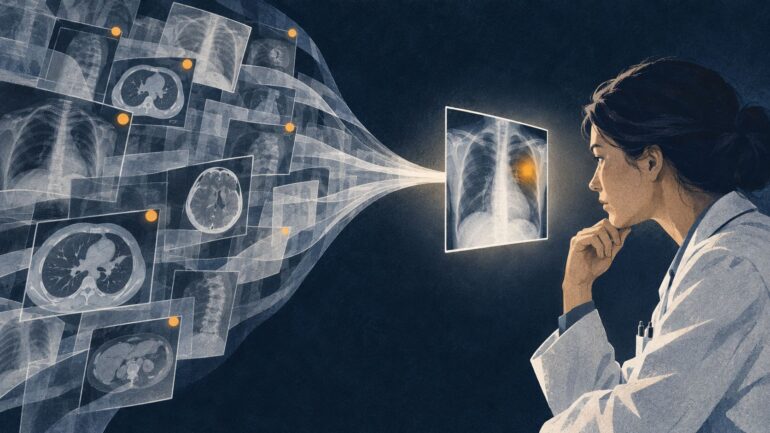
Artificial intelligence is gradually becoming part of many areas of medicine. At DICO by Expert Radiotech, we examined research across radiology and other medical specialties to understand how AI is changing clinical workflows. Our analysis highlights a growing challenge: as medical information becomes more abundant, human attention is becoming an increasingly limited resource. In a recent survey, one in five UK general practitioners said they had used AI in their clinical work,
mainly to prepare documents, consider possible diagnoses and suggest treatment options.
At DICO by Expert Radiotech, we examined research across radiology and other medical specialties to understand how AI is changing clinical workflows. Our analysis highlights a growing challenge: as medical information becomes more abundant, human attention is becoming an increasingly limited resource.
One of these tools' main advantages is how quickly they can process large amounts of information. For example, AI can pull out the key details from a long electronic medical record in seconds. Intensive care doctors estimate that reviewing a new patient’s record takes around 15 minutes, and up to 25 minutes in more complex cases. An AI summary could give doctors more time to focus on their patients.
But gathering information quickly is only part of the job. Doctors still need to check it and decide what matters for each patient. The more hypotheses and recommendations AI produces, the more important this question becomes: which of them really deserve a specialist’s attention?
From Whole Studies to Specific Tasks
Radiology work can be split into specific tasks, with each handled by the right expertise. AI can help with measurements or flag urgent scans, while a subspecialist reviews a difficult finding.
Studies show how this can help: AI-assisted tumour measurements took about a third less time, while flagging possible pulmonary embolism shortened the wait for review.
Specialist input can also affect care. In one study, a second opinion from oncologic neuroradiologists could have changed treatment or disease stage in 42 of 283 cases.
The radiologist in charge brings these inputs together with the patient’s history, decides what they mean for the patient and writes the final report.
Not Every Alert Matters Equally
AI can generate an almost endless stream of findings and alerts, but doctors have limited time and attention. Each alert needs to be checked: was something actually missed, and could it affect the patient’s treatment? The challenge is deciding which signals deserve that attention.
In a study of 25 104 chest X-rays, AI flagged discrepancies with doctors’ reports in 5,289 cases – 21.1% of the total. After further review, a radiologist judged only 47 of those cases to involve clinically relevant missed findings. An alert alone does not show how important a finding is for the patient.
A similar approach was tested with CT scans. AI flagged possible brain bleeds, blood clots or neck fractures. Of 111,674 scans, 46 were sent for a second review. Doctors confirmed a missed finding in 26 of those cases. This shows how AI can help direct attention to a small number of cases that may need another look.
Future systems will need to do more than produce information. They will need to filter and prioritize it, helping doctors see what could affect care and when their input is needed. Human attention is a limited resource, and using it well should be a core part of the system’s design.
This Is Not Just a Radiology Issue
The same challenge comes up in other areas of medicine. During a colonoscopy, AI can highlight polyps the doctor may have missed.
In the COLO-DETECT study, more than 2,000 patients were randomly assigned to have either a standard colonoscopy or one with AI assistance. Adenomas were found in 56.6% of patients in the AI group, compared with 48.4% in the standard-colonoscopy group. The algorithm helped draw attention to possible findings, but the doctor still performed the procedure and decided what to do with each area.
In outpatient care, AI can take on another task: drafting notes from appointments. The software listens to the conversation between a doctor and patient, then prepares a draft medical note for the doctor to review. A survey study across two health systems included 1,430 clinicians who used this technology. Its use was associated with lower burnout at one system and better self-reported well-being at the other. But the study was not controlled, and only some participants responded to the follow-up surveys, so the results should be interpreted with caution.
These examples involve different tasks: in one, AI helps spot a possible finding; in the other, it reduces the work of documentation. In both cases, the technology needs to fit into the clinic’s workflow. Doctors need to know when a summary is enough, when they need an alert right away, and when to ask a colleague for help. If AI creates a stream of extra alerts or its output is difficult to check, it can add to the workload instead of reducing it.
Who Should See an AI Finding, and When?
Even an accurate alert is of little use if it does not reach a doctor who can act on it. And when a colleague is asked to review a complex case, they need more than a scan or test result – they need a clear question.
In one study, radiologists sent colleagues 114 alerts about disagreements in reports. In 64 cases, the patient’s care plan changed. These alerts were rare – about one for every 16,500 reports – but they could affect decisions about patient care.
At the same time, doctors should not be flooded with alerts. One study looked at more than 157,000 medication-related clinical decision-support alerts. Doctors often overrode some types of alerts without changing the prescription. When there are too many signals, important ones can be easier to miss.
So a system needs to do more than pass an AI result to a doctor. It needs to work out who should see it and how quickly. What should be shown right away, what can go into a summary, and what does not need a separate alert? The question is not only when a doctor should see an AI result, but also which results deserve their attention at all.
What Needs to Change?
There is more and more data in medicine, but doctors have no more time or attention to give it. AI can already summarize records, flag abnormalities, and suggest possible next steps. The question now is how to make good use of all this information.
Future systems will need to route information based on the clinical context:
- Send urgent alerts straight to the doctor on call.
- Direct complex cases to the right specialist, with a clear question for them to answer.
- Add background information to the patient’s record without interrupting the care team unnecessarily.
Doctors should also be able to understand why AI flagged something and how reliable its conclusions are.
Success should be measured by whether these systems help doctors make the right decision sooner. That means bringing important signals forward, involving the right expertise and knowing when no interruption is needed.
The next generation of medical AI infrastructure will not be defined by how much information it can generate, but by how intelligently it allocates human attention.