
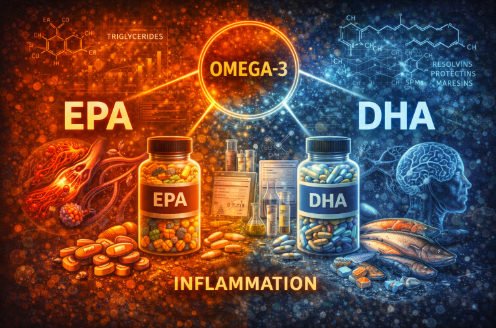
The omega-3 story used to be simple. Eat more fatty fish, take fish oil if you do not, and expect calmer inflammation. Now the conversation has fractured into a debate that sounds almost technical, EPA versus DHA, purity versus blends, triglycerides versus inflammation, and food versus capsules. Underneath that debate is a bigger shift in nutrition culture. People are no longer satisfied with the phrase anti inflammatory. They want to know what kind of inflammation is being targeted, how it is measured, and whether the effect shows up in real outcomes.
That shift is why the keyword omega-3 anti-inflammatory has become both popular and confusing. It sits at the intersection of strong biology, mixed trial results, and aggressive marketing. EPA and DHA are both omega-3 fatty acids found in seafood, and the body does not efficiently make meaningful amounts of them from plant-based ALA, so food and supplements are the practical ways to raise levels. The question is what happens after you raise them, and whether the ratio matters for the result you care about.
Why the EPA versus DHA debate exists at all
EPA and DHA are often bundled together as if they do the same job. They do not.
EPA is frequently discussed as a competitor to arachidonic acid in the production of signaling molecules that can amplify inflammation. DHA is often framed as more structural, a major component in cell membranes, especially in the brain and retina, and also a parent molecule for several mediators linked to inflammation resolution. The debate exists because different products emphasize different endpoints. A sports recovery audience may care about soreness and joint comfort. A cardiometabolic audience may care about triglycerides and event reduction. A dermatology audience may care about barrier repair and flare frequency. One blend rarely optimizes all of those targets at the same time.
So EPA versus DHA is not just chemistry. It is a proxy for what the buyer expects the supplement to do.
The most important reframing in 2025 is resolution, not suppression
A useful modern way to understand omega-3 anti-inflammatory claims is to separate two ideas.
The first is inflammation suppression, reducing the production of inflammatory signals.
The second is inflammation resolution, turning on programs that end inflammation and restore tissue balance.
This distinction matters because many omega-3-derived molecules are studied as specialized pro-resolving mediators, often called SPMs. These include families derived from EPA and DHA, such as resolvins, protectins, and maresins. The resolution idea changes the narrative. Instead of asking whether omega-3s blunt the immune response, it asks whether they help the body complete the cycle and move out of a chronic inflammatory state.
This is also where the EPA and DHA conversation gets more interesting. Both can contribute to resolution pathways, but DHA-derived mediators have received significant attention in resolution science, while EPA-derived mediators are also active and studied.
What the biomarker literature suggests and why it still disappoints people
If you track the research by inflammation markers, omega-3 supplementation often looks encouraging.
An umbrella meta-analysis from 2022 reported that omega-3 supplementation in adults can improve CRP, TNF alpha, and IL-6 across various health conditions. Another 2024 analysis also reported reductions in inflammatory markers such as IL-6, TNF-alpha, and CRP in pooled results.
But consumers do not take supplements to improve CRP on a lab report. They take them to feel better and to lower the risk.
This is where the debate heats up. Marker changes can be real while day-to-day outcomes remain subtle, inconsistent, or dependent on the starting point. Someone with low baseline omega-3 intake and a higher inflammatory burden may notice a difference. Someone already eating fish twice a week may notice nothing. The average effect in a meta-analysis can mask that.
It also matters that EPA and DHA may not differ dramatically in some inflammation marker comparisons. A 2024 review in Clinical Nutrition ESPEN discussed differential effects and noted that some studies did not show significant differences between EPA and DHA on changes in CRP, IL-6, and TNF-alpha. That does not mean the two are identical. It means the most common lab markers may be too blunt to capture their most meaningful differences.
The cardiology trials turned EPA into a headline and DHA into a question mark
If you want to understand why the market now sells EPA heavy products, look at the cardiovascular trial history.
REDUCE IT tested a high-dose purified EPA product, icosapent ethyl, in high-risk statin-treated patients with elevated triglycerides and reported reduced cardiovascular events, reigniting interest in omega-3 therapy. In contrast, the STRENGTH trial tested a high-dose EPA plus DHA formulation and found no reduction in major adverse cardiovascular events, and it was stopped for futility.
That split outcome became fuel for an oversimplified conclusion: EPA works, DHA does not. Reality is messier. Trial populations, formulations, placebo choices, and achieved blood levels differ. A 2024 review in Frontiers in Nutrition specifically discusses discrepancies between major omega-3 trials and why direct comparisons are difficult.
Even within REDUCE IT, biomarker changes do not fully explain the event reduction. A Circulation analysis of biomarkers reported that allocation to icosapent ethyl had minimal effects on a series of biomarkers associated with atherosclerotic disease. This is important for a nutritional theme because it suggests omega-3 effects may involve pathways not captured by standard inflammation labs, or that outcomes could reflect a mix of lipid and non-lipid mechanisms.
For readers searching for omega-3 anti-inflammatories, the practical lesson is this. The EPA versus DHA debate often uses heart trials as evidence, but heart trials were not designed as pure inflammation trials. They were outcome trials in specific risk groups.
The hidden trade-off is dose, not just type
One reason omega-3 conversations have become more cautious is the recurring signal around atrial fibrillation risk at higher supplemental doses.
A 2022 review in a PMC article summarizes evidence that omega-3 fatty acids were associated with a higher risk of incident atrial fibrillation compared to placebo in pooled trial data. A 2023 JACC review discusses similar findings and reports a pooled increased atrial fibrillation risk across trials that captured AF endpoints.
This does not mean omega-3 foods are dangerous. Dietary omega-3 intake is often studied separately and can show different associations than pharmacologic dosing. The key point is that the supplement version of omega-3 anti-inflammatories can become a high-dose drug, like exposure, especially at 4 grams per day levels used in some cardiology trials.
That trade-off is part of the new angle on the EPA versus DHA debate. Sometimes the most important question is not which one is better. It is whether the dose and context fit the person.
A nutrition-first way to think about EPA and DHA
If you approach this as a nutrition problem, not a supplement problem, the debate looks different.
Food sources of EPA and DHA come with protein, selenium, iodine, and other nutrients, depending on the fish, and they deliver omega-3s in a dietary pattern context. The NIH fact sheet emphasizes that EPA and DHA are found in fish and seafood and that consuming them directly is the practical way to raise levels.
A realistic nutrition angle is to treat fish intake as the baseline and supplements as targeted tools.
If your goal is general omega-3 anti-inflammatory support for someone without a clinical condition, the most defensible strategy is consistent dietary intake of fatty fish, plus overall dietary patterns that reduce inflammatory load, like higher fiber, less ultra-processed fat, and better micronutrient status. Omega-3s are one lever, not the whole system.
If your goal is targeted triglyceride lowering or specific clinician-guided therapy, then formulations and doses matter more, and the EPA versus DHA distinction becomes more consequential, as shown by differences between major high-dose trials.
The practical misunderstanding is the word anti-inflammatory
The word anti-inflammatory makes people think in dramatic before-and-after terms. In nutrition, effects are often slow and conditional.
Here are three examples that show why expectations break.
The athlete example. A person expects fish oil to erase soreness. Studies on exercise recovery show mixed results, and in some cases, no changes in markers like IL-6 or TNF-alpha after supplementation, suggesting omega-3s do not act like a painkiller.
The skin example. A person with eczema expects fewer flares. Omega-3s can be supportive, but skin inflammation is strongly influenced by barrier care, irritants, and allergic triggers. Omega-3s may help in the background, not replace the basics.
The metabolic example. A person with high triglycerides expects a supplement to fix the problem while keeping the same diet. High-dose omega-3 formulations can lower triglycerides, but food patterns, alcohol, refined carbohydrates, and weight trends still dominate the outcome.
These examples bring the debate back to nutrition. EPA and DHA are not substitutes for dietary structure. They are nutrients that work inside the dietary structure.
Where the debate is heading next
The research frontier is moving toward measurement and personalization.
One growing trend is the use of the Omega 3 Index, defined as the percentage of EPA plus DHA in red blood cell membranes, as a biomarker of omega-3 status. This is appealing because it shifts the conversation away from label dosing and toward achieved tissue levels. It also reframes EPA versus DHA in a more practical way, raises status to a healthier range first, then worries about fine-tuning.
Another trend is the continued exploration of SPM biology and whether boosting resolution mediators can translate into clinical benefits across inflammatory conditions. This may eventually make the EPA versus DHA debate less binary and more about which pathway is being targeted.
Closing perspective
The EPA versus DHA debate is often presented like a rivalry. A more useful way to view it is as a sign that nutrition audiences have matured. People are asking better questions about omega-3 anti-inflammatory claims; they want outcomes, not slogans, and they are noticing that fish, capsules, and high-dose prescriptions behave differently.
EPA and DHA both matter, but they matter differently, and the most important variables are often baseline status, dietary pattern, and dose. The next phase of the omega-3 conversation will likely move away from arguing over one molecule and toward a more measurable approach that respects both biology and real-world risk trade-offs.