
Post-Traumatic Stress Disorder (PTSD) is often mischaracterized as a disorder of memory—a replay of terrible events that won’t stop. But true trauma, especially when it stems from early childhood experiences, is not just about what you remember; it is about who you became to survive it.
Traditional talk therapies often address the adult survivor, trying to rationalize irrational fears using the prefrontal cortex. This approach frequently fails because the root of the trauma doesn’t live in the rational adult brain. It lives deep in the limbic system and the subconscious, locked away in the frozen persona of the child who first experienced the terror.
In my years of working with Ibogaine, I have come to view it not just as a medicine, but as a bridge to the subconscious. It is a psycho-spiritual archaeological tool that allows us to dig past the defenses of the adult to rescue the most vital, yet most wounded, part of the psyche: The Child Archetype.
Healing PTSD with Ibogaine is a rescue mission for the soul. Here is how this profound medicine facilitates that journey through the lens of depth psychology.
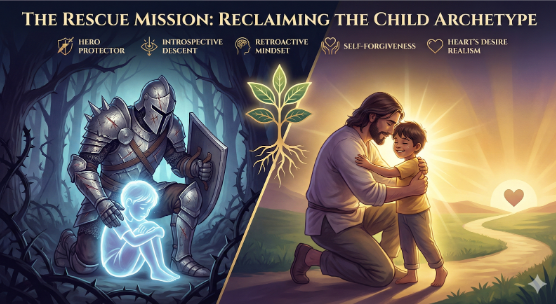
1. The Birth of the “Hero” Protector
When a young child experiences overwhelming trauma—whether abuse, neglect, or witnessing violence—they do not have the cognitive or emotional resources to process it. To survive psychically, a fracture occurs. The vulnerable, innocent part of the self (the true Child Archetype) is hidden away in the dungeon of the subconscious for safekeeping.
In its place, a new personification emerges. We call this the “Hero” Protector.
This protector personality is forged in fire. Its sole job is to ensure the trauma never happens again. It is hyper-vigilant, armored, and reactive. In adulthood, this “Hero” is the part of you that always scans exits, that trusts no one, or that numbs intense emotions with substances before they can become overwhelming.
While this Hero saved your psychological life as a child, it becomes a prison as an adult. The Protector’s armor, once necessary, now prevents connection, joy, and vulnerability. The adult suffering from PTSD is essentially being run by a terrified, heavily armed child persona that doesn’t realize the war is over.
2. The Introspective Descent: Meeting the Innocent Self
Ibogaine is unique among psychoactive substances in its ability to generate a long-lasting, lucid “dream state” while the patient is fully awake. It temporarily dissolves the ego’s rigid defenses—essentially telling the armored “Hero” Protector to stand down.
Once these defenses are lowered, the patient can descend into their own subconscious. This is often described as a journey into a basement or a cave where they encounter the personification of their younger self—the part that was abandoned at the time of trauma.
This is not the reactive, scared child. This is the Archetypal Innocent Child—the essence of who the person was before the world hurt them. This archetype holds the capacity for wonder, unfiltered joy, trust, and creativity.
The Ibogaine experience allows the adult self to meet this child personality without the usual barriers of shame or fear. It is a reunion. The adult can finally offer the safety and validation that was missing decades ago. This reconnection is the metabolic fuel for healing PTSD, proving to the nervous system that the fragmented parts of the self can exist together safely.
3. The Retroactive Mindset: Diverging from the Blueprint of Trauma
Early childhood trauma creates a neurological blueprint. The brain learns: “The world is unsafe; connection leads to pain.” Every subsequent growth pattern—how you choose partners, how you handle conflict, how you view yourself—stems from that corrupted root.
Ibogaine facilitates what I call a “Retroactive Mindset.” During the “life review” phase of the treatment, patients often revisit traumatic memories, not as the helpless victim, but as an objective, compassionate observer.
This reality-testing is crucial. The patient sees that the patterns of behavior they developed—the addiction, the isolation, the aggression—were logical responses to an illogical situation at the time. They were survival mechanisms.
By seeing the root cause with adult clarity, neuroplasticity is triggered. The brain realizes it is no longer bound to that old blueprint. The patient gains the cognitive flexibility to diverge away from unhealthy growth patterns. They recognize that the armor of the “Hero” is no longer required for the current environment, allowing them to lay down their weapons.
4. The Alchemy of Forgiveness: From Inner to Outer World
The most insidious damage of childhood trauma is the internalized belief that the abuse was somehow deserved. The child ego-state takes on the blame to protect its attachment to the caregivers. “They aren’t bad; I must be bad.”
This internalized shame is the engine of PTSD. It is why so many survivors are locked in cycles of self-sabotage.
Ibogaine is a powerful solvent for shame. When the adult patient reconnects with the innocent Child Archetype during the session, the absurdity of that blame becomes undeniable. You cannot look at a terrifying four-year-old and conclude it was their fault.
This sparks profound self-forgiveness. The adult forgives the child they once were for not being strong enough to stop the trauma, and forgives the “Hero” protector for the messy ways it tried to survive.
This internal forgiveness is the prerequisite for external peace. You cannot forgive the world around you while you are at war with yourself. By absolving the inner child, the patient releases the need to project their pain onto others, breaking the generational cycle of trauma.
5. Grasping Realism: Choices from the Heart’s Desire
PTSD is a distortion of reality. It views the present moment through the lens of past danger. When you live in survival mode, you do not make choices based on what you want; you make choices based on what will keep you safe.
As the Ibogaine wears off and the integration process begins, a new realism begins to grip the patient. The “Hero” protector is no longer screaming that danger is imminent. The nervous system regulates.
In this new quiet, the voice of the reclaimed Child Archetype can finally be heard. This voice doesn’t speak of survival; it speaks of desire.
Patients find they can finally make choices stemming from the heart’s uttermost desires, rather than from fear. They might pursue the art career they abandoned, leave the “safe” but dead partnership, or simply allow themselves to feel joy without waiting for the other shoe to drop.
Conclusion: The Integrated Adult
Healing PTSD with Ibogaine is not about erasing the past or killing the “Hero” protector. It is about integration. It is about thanking the protector for its service and allowing it to retire, while bringing the exiled Child Archetype back to the surface.
When these fractured personifications merge, the result is a whole, functional adult—one capable of remembering the trauma without reliving it, and capable of moving forward with the innocence of a child and the wisdom of a survivor.
For more information visit https://ibogaineclinic.com/ibogaine-therapy-for-trauma/