
In the realm of mental health, “Situational Depression” (Adjustment Disorder) is often dismissed as merely “having a hard time.” This is a dangerous oversimplification. Situational depression is a neuro-chemical collapse triggered by external stressors. It is not just about feeling sad; it is about a nervous system that has been overwhelmed by its environment.
At Ibogaine by David Dardashti, we do not use a standard dose for this condition. We use a Variable Assessment Protocol.
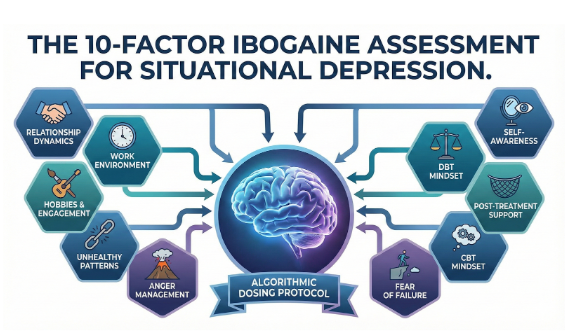
Unlike chemical depression (which is a hardware malfunction), situational depression is a software glitch caused by incompatible inputs. To treat it, we must analyze those inputs. Our proprietary algorithm inputs ten specific lifestyle and psychological variables to calculate the precise “Psycholytic Dose” required to help the patient process their reality without destabilizing their psyche.
Here are the 10 factors we assess to engineer your recovery.
1. Relationship Dynamics: The Social Mirror
The first variable we quantify is the health of your interpersonal connections.
- The Assessment: Is the patient in a supportive marriage, a toxic partnership, or isolated?
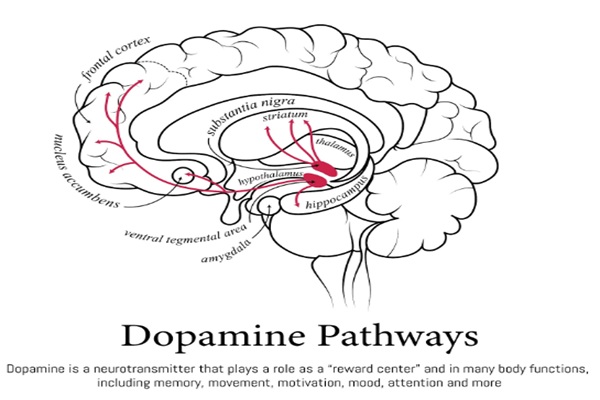
- The Protocol Adjustment: If a patient is returning to a toxic relationship, the Ibogaine dose is adjusted to prioritize boundary setting and ego-strengthening. We need to stimulate the release of dopamine and oxytocin to rebuild self-worth, ensuring the patient has the chemical resilience to say “no” when they return home.
2. Work Environment: The Cortisol Factor
We cannot treat depression if we ignore the 8 hours a day you spend at work.
- The Assessment: We distinguish between “high pressure” (e.g., a CEO) and “toxic stagnation” (e.g., a dead-end job).
- The Protocol Adjustment: For high-stress professionals, the brain is often bathed in cortisol. The protocol will focus on adrenal restoration. We may incorporate specific pre-treatment boosters to lower cortisol levels before the Ibogaine is administered, ensuring the medicine isn’t fighting an uphill battle against stress hormones.
3. Hobbies and Engagement: The Dopamine Baseline
What lights you up? If the answer is “nothing,” we have a baseline problem.
- The Assessment: We look at what the patient used to enjoy.
- The Protocol Adjustment: This helps us map the Reward Pathway. If a patient has abandoned all hobbies, it indicates severe anhedonia (inability to feel pleasure). The dosing strategy shifts to target the Mesolimbic Pathway, using a specific saturation level to “jumpstart” the dopamine receptors that govern anticipation and joy.
Shutterstock
4. Unhealthy Patterns of Behavior: The Loop Breaker
We analyze the mechanisms used to cope—binge eating, doom-scrolling, or substance misuse.
- The Assessment: We identify the specific triggers for these loops.
- The Protocol Adjustment: Ibogaine is an “interrupter.” By identifying the specific behavioral loop, we can time the treatment to occur during a window of high craving or high distress. The medicine physically resets the neural groove associated with the habit, turning a deep canyon of behavior into a flat plain of possibility.
5. Anger Management: The Repressed Volatility
Depression is often described as anger turned inward.
- The Assessment: We screen for repressed rage vs. explosive outbursts.
- The Protocol Adjustment: For patients with repressed anger, we use a higher “agitation dose” during the initial phase. This allows the anger to bubble to the surface and be purged somatically (physically) during the treatment. It acts as a pressure valve release, often curing the depressive symptoms instantly by removing the heavy energy required to keep the anger suppressed.
6. Fear of Failure: The Paralysis Metric
Many cases of situational depression are actually “failure to launch” or “fear of collapse.”
- The Assessment: We measure the patient’s risk tolerance and anxiety regarding the future.
- The Protocol Adjustment: This requires a protocol focused on GDNF (Glial Cell Line-Derived Neurotrophic Factor). We aim to increase neuroplasticity in the prefrontal cortex—the area responsible for planning and executive decision-making. By enhancing this area, we chemically empower the patient to visualize success rather than fixating on failure.
7. Cognitive Behavioral Mindset (CBT): The Internal Dialogue
How does the patient talk to themselves?
- The Assessment: We listen for cognitive distortions (e.g., “I am always a disaster”).
- The Protocol Adjustment: The Ibogaine experience is often a rapid-fire review of memories. For patients with negative CBT loops, we structure the integration phase to challenge these thoughts immediately post-treatment. The medicine makes the brain malleable; we use that malleability to rewrite the internal script from “I can’t” to “I am.”
8. Dialectical Behavioral Mindset (DBT): Emotional Regulation
Can the patient hold two opposing truths at once? (e.g., “I am flawed, and I am worthy.”)
- The Assessment: We test for emotional volatility and black-and-white thinking.
- The Protocol Adjustment: DBT emphasizes “Radical Acceptance.” The dosing here is tuned to induce a state of observer consciousness. We want the patient to float above their emotions during the treatment, observing their trauma without becoming it. This instills a permanent capacity for emotional regulation that lasts long after the medicine leaves the system.
9. Post-Treatment Support Systems: The Safety Net
A treatment is only as good as the landing.
- The Assessment: Who is waiting for you at the gate?
- The Protocol Adjustment: If a patient lacks a support system, the algorithm mandates a longer “Aftercare Window” at our facility. We do not discharge patients into a void. We extend their stay to ensure the Noribogainestabilization is fully locked in, effectively acting as a biological support system until they can build a social one.
10. Self-Awareness: The Insight Quotient
Finally, we assess the patient’s capacity for introspection.
- The Assessment: Does the patient blame the world, or do they look inward?
- The Protocol Adjustment: For patients with low self-awareness, we utilize a “Stair-Step Dosing” method. We start with smaller doses to gently peel back the ego defenses, increasing the dose only as the patient demonstrates the capacity to handle the insights. This prevents psychological shock and ensures the revelations are integrated, not rejected.
Conclusion: The Algorithm of You
Situational depression is not a generic disease, and it should not be treated with a generic pill. It is a complex interaction between your biology and your biography.
By analyzing these 10 factors, Ibogaine by David Dardashti moves beyond simple “treatment” and enters the realm of Life Architecture. We don’t just clear the fog of depression; we give you the navigational tools to steer your ship through the storm.
For more information https://ibogaineclinic.com/ibogaine-treatment-for-depression/