
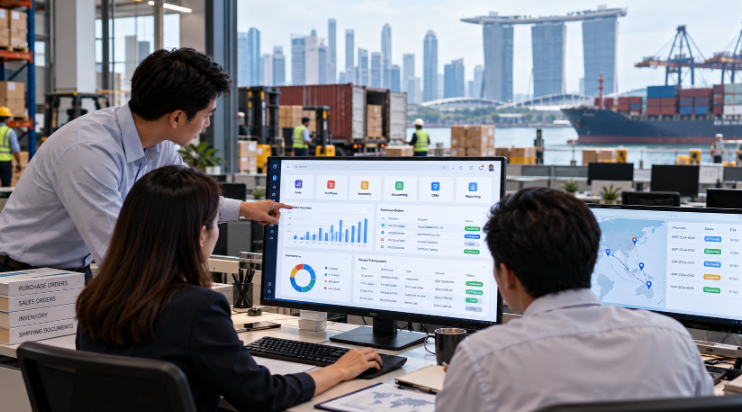
Singapore has been a trading hub for two centuries. Commodities, electronics, chemicals, food products, machinery parts and consumer goods all pass through the island on their way to somewhere else. Many of the firms handling that flow are small or mid-sized, and for years plenty of them ran on spreadsheets, accounting software and the memory of a few experienced staff. That arrangement still works at a certain size. Beyond it, cracks start to show, and more trading companies are now looking seriously at ERP. This article explains what is driving that shift and what firms should think about before committing.
Margins Are Thin and Mistakes Are Expensive
A trading business earns its living on the gap between what it pays and what it charges. When margins sit in the low single digits, a wrong cost calculation, a missed supplier price change or a shipment invoiced late can wipe out the profit on several deals. Spreadsheets make these errors easy to introduce and hard to trace.
An ERP system keeps purchase orders, sales orders, landed costs, payments and stock movements in one place. That means a sales manager can quote with the current cost in front of them, and finance can see the true margin on a deal after freight, insurance, duties and exchange differences. Many owners say the first benefit they notice is simply trusting the numbers.
Multi-Currency and Cross-Border Complexity
Most Singapore traders deal in several currencies at once. A company might buy in US dollars, sell in Singapore dollars, pay freight in euros and settle with a customer in Indonesia in rupiah. Each step creates exchange gains or losses that someone has to record properly.
Modern ERP platforms handle multi-currency pricing, revaluation and bank reconciliation as standard functions. They also manage the paperwork that follows goods across borders, including commercial invoices, packing lists, certificates of origin and customs declarations. Integration with TradeNet, the national trade declaration system, reduces the amount of re-keying between internal records and government filings. For firms exporting under free trade agreements, keeping origin data attached to each product line makes preferential duty claims far less painful.
Inventory Management Across Warehouses and Partners
Traders often hold stock in unusual places. Some goods sit in a bonded warehouse, some in a third-party logistics facility in Jurong, and some in a customer’s own premises under a consignment arrangement. Others are never touched at all, moving directly from supplier to buyer. Tracking all of this on paper or in disconnected files leads to the classic problems of phantom stock, double-selling and slow-moving items that nobody notices until the audit.
Good inventory management inside an ERP gives a single view of what is owned, where it is, what has been allocated and what is on its way. Batch and expiry tracking matter for food, pharmaceuticals and chemicals. Reorder suggestions based on actual sales history help buyers avoid both stockouts and overbuying. Because warehouse space in Singapore is expensive, even modest reductions in excess stock translate into real savings.
Business Automation Eases the Pressure on Staff
Hiring in Singapore is not easy. Quotas and levies on foreign workers, a competitive local labour market and rising wages push owners to get more from the team they have. Much of a trading company’s administrative load is repetitive: raising purchase orders, matching invoices to deliveries, chasing approvals, generating statements and preparing shipping documents.
Business automation inside an ERP can take over a large share of this work. Approval flows can route by value or supplier. Three-way matching between purchase order, goods receipt and supplier invoice can happen automatically, with only exceptions sent to a person. Overdue payment reminders can go out on a schedule. None of this is dramatic, but it frees staff to spend time on negotiation, customer relationships and supplier sourcing, which is where trading firms actually create value.
Compliance Is Getting Tighter
Regulatory expectations in Singapore are clear and increasingly digital. GST rules require accurate records and correct treatment of zero-rated exports, imports and transactions involving schemes such as Major Exporter Scheme or Approved Third Party Logistics arrangements. IRAS also continues to encourage e-invoicing through InvoiceNow, the national network built on the Peppol standard, and adoption is expanding among businesses of all sizes.
Companies in higher-risk sectors, such as precious metals, commodities or dual-use goods, face additional controls around customer due diligence and sanctions screening. An ERP does not replace a compliance programme, but it can hold the records, audit trails and approval history that auditors and regulators ask to see. Having these in one structured system is far easier than assembling them from emails when a request arrives.
ERP Integration Connects the Rest of the Business
Few trading companies run only one piece of software. There may be an e-commerce storefront, a customer relationship tool, a shipping platform, bank feeds, a customs filing service and a payroll system. When these do not exchange data, staff fill the gaps manually, and errors follow.
This is why ERP integration in Singapore is often the most important part of a project. Typical needs include:
- Syncing online orders and stock levels between a webshop or marketplace and the ERP
- Connecting freight forwarders and courier platforms for tracking and cost capture
- Linking banks for automated reconciliation and payment files
- Exchanging purchase orders and invoices with larger customers through standard formats
Open APIs have made these links easier to build than a decade ago, but they work only if product codes, units of measure and customer records are clean. Many firms spend the first few weeks of a project on data cleanup, which feels slow but pays off later.
Digital Transformation Is About Decisions, Not Dashboards
The phrase digital transformation is overused, yet the underlying idea is simple. A business that can see its position in real time makes better and faster decisions. For a trading firm, that might mean knowing which customers pay late, which products tie up the most cash, or which supplier consistently delivers behind schedule.
Government support has encouraged this move. Programmes from Enterprise Singapore and IMDA, including the Productivity Solutions Grant and the Enterprise Development Grant, have helped many small and medium enterprises adopt digital tools, though eligibility and funding terms change, so companies should check current details directly. A grant can reduce the cost of a project, but it should not be the reason for starting one.
Custom Build, Package or Something in Between
Choosing the right approach is one of the harder decisions. Packaged software offers a proven foundation and faster deployment. Trading businesses, however, often have quirks: unusual pricing structures, commission arrangements, back-to-back contracts, or specialised commodity grading. This is where ERP development services in Singapore come into the picture, since a local team can extend a standard core with tailored workflows and reports without rebuilding everything from scratch.
A hybrid model is common. Finance, purchasing, sales and inventory run on a standard platform, while a few custom modules handle the processes that make the business different. Whichever path a company takes, it should document its requirements in detail, ask how upgrades will be managed, and confirm who will own the system after go-live.
Practical Lessons from Firms That Have Done It
Companies that report good outcomes tend to share several habits. They start with a clear list of problems rather than a list of features. They involve the people who actually raise orders and handle shipments, not just directors and accountants. They run a pilot or phased rollout instead of switching everything over in a single weekend. And they plan for training and a settling-in period, because productivity often dips briefly before it improves.
They also resist the urge to over-customise early. It is usually wiser to run the standard process for a few months, learn what truly needs to change, and then adjust.
Final Thoughts
Trading companies in Singapore invest in ERP for practical reasons: thinner margins, more cross-border complexity, tighter compliance, a constrained labour market and customers who expect accurate, timely information. The technology itself is only part of the story. What matters is whether the business ends up with cleaner data, simpler workflows and a clearer view of its own performance.
For firms still relying on spreadsheets, there is no need to overhaul everything at once. Many begin with a single area, such as inventory records or purchase approvals, prove the value there and expand step by step. Over time, those steady improvements can turn a fragile, person-dependent operation into one that is ready to grow.