
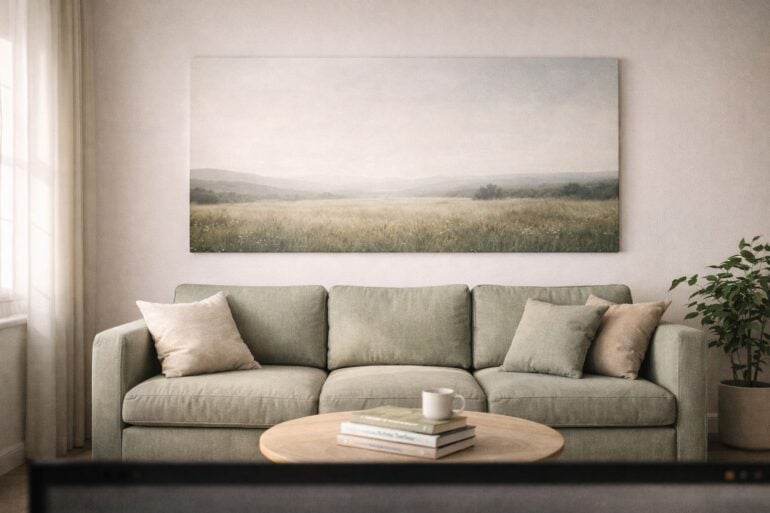
When we talk about the home as a health environment, the conversation usually focuses on the obvious variables: air quality, noise levels, sleep conditions, food storage. What’s almost never discussed — despite a substantial research literature on the subject — is the visual environment: the images, colours, and spatial qualities that your perceptual system processes continuously from the moment you enter a room.
This is an evidence-based look at what that research actually says — about the relationship between visual environments and stress physiology, mental health outcomes, recovery, and cognitive function — and what it means practically for how we think about the spaces we inhabit.
The Body’s Response to Visual Environments
The idea that looking at something can change what happens inside your body sounds like wellness marketing. The physiology, however, is straightforward.
The visual cortex is the largest single functional area in the human brain, accounting for roughly 30% of the cortical surface — compared to approximately 8% for somatosensory processing and 3% for motor control. Visual input doesn’t arrive in the brain and sit passively. It actively engages emotion-processing regions (the amygdala), memory systems (the hippocampus), and the autonomic nervous system — the system that governs the stress response via the hypothalamic-pituitary-adrenal (HPA) axis.
This neural architecture explains why visual environments can affect physiological stress markers. When the visual system encodes a threatening, chaotic, or simply aesthetically aversive environment, it can trigger low-level activation of the stress response — elevating cortisol, increasing heart rate variability in a stress direction, and sustaining a low-level alert state that the body pays a metabolic cost to maintain.
Conversely, visual environments perceived as safe, beautiful, or naturalistically restorative can activate the parasympathetic nervous system — the calming branch — producing effects that are measurably opposite to those of the stress response.
Roger Ulrich and the View Through the Window
The foundational study in this field is Roger Ulrich’s 1984 paper in *Science*, which remains one of the most-cited pieces of research in environmental health. Ulrich analysed surgical recovery records from a Pennsylvania hospital over a nine-year period, comparing patients whose recovery room windows faced a stand of deciduous trees with patients whose windows faced a brick wall.
The findings were specific and significant: patients with the tree view had shorter post-operative hospital stays (7.96 days versus 8.70 days on average), required fewer doses of moderate and strong analgesics (1.0 versus 2.48 per patient), received fewer negative evaluative notes from nurses (“upset and crying” type assessments), and had lower self-reported pain scores.
The only variable between the groups was what they could see. Natural imagery — even mediated through a window — had a measurable effect on pain experience, recovery time, and nursing assessment of patient wellbeing.
This research was specific to hospital settings, but subsequent studies have replicated the general principle across multiple contexts: workplaces, schools, residential environments, and care settings for elderly patients all show consistent evidence that visual access to natural imagery produces measurable wellbeing benefits.
Stress Reduction and the Role of Natural Imagery at Home
Stress Reduction Theory, developed by Ulrich and published in his 1983 work on natural environments, proposes that humans have an evolutionary predisposition to respond positively to natural settings — specifically, settings that provided safety and resources in ancestral environments. Savannahs, water bodies, tree canopies, and open landscapes with both prospect (distant views) and refuge (shelter nearby) produce the strongest autonomic calming responses.
The practical implication is that natural imagery in the home — not just views, but photographs, paintings, and prints depicting natural environments — activates similar (if attenuated) calming responses. A high-quality photographic print of a forest scene, a coastal landscape canvas, or a large-format botanical illustration isn’t merely decorative. It’s a visual stimulus that your nervous system processes in a specific and measurable way.
Research published in the *Journal of Environmental Psychology* in 2019 found that exposure to high-quality photographic prints of natural scenes in a home environment produced significant reductions in salivary cortisol over a 30-minute exposure period, compared to a control condition featuring urban street photography. The cortisol effect was consistent across all participants but strongest in those with higher baseline stress levels — exactly the population for whom the intervention is most relevant.
Mental Health and the Aesthetic Environment
The relationship between aesthetic environment quality and mental health outcomes is less mechanistic than the stress physiology literature but equally consistent in direction.
A 2020 systematic review published in *Arts in Psychotherapy* examined 29 studies on visual art and mental health across clinical and non-clinical populations. Across the review, visual engagement with art was associated with reductions in depression and anxiety symptoms, improvements in mood, increased sense of meaning and purpose, and — in clinical populations — reduced reliance on pharmacological symptom management. The effect sizes were modest but consistent across methodologies and populations.
The mechanism hypothesised in most of this literature is a combination of: the positive affect generated by aesthetic experience (well-established in the hedonic psychology literature), the restorative attention effect (whereby looking at engaging visual content gives directed attention a rest), and the meaning-making dimension (art that resonates personally activates narrative processing systems that are linked to sense of coherence and psychological wellbeing).
For people managing chronic stress, subclinical depression, or anxiety in the absence of formal clinical treatment, the environmental art quality of their home is a factor worth considering alongside the more commonly discussed lifestyle interventions.
Colour, Autonomic Response, and Emotional Regulation
Colour is the most immediate dimension of visual environment in terms of autonomic effect — the one that operates fastest and requires least cognitive engagement to produce a response.
The psychophysiology of colour has been studied since the mid-twentieth century. The broad patterns are consistent, even though individual variation is significant.
Red wavelengths produce measurable increases in arousal — heart rate, skin conductance, and perceived effort all show red-related elevations in controlled studies. This is why red environments increase aggression scores in psychological testing and why casinos and fast-food environments (which both benefit from elevated arousal) use red prominently.
Blue wavelengths produce the opposite pattern — reduced heart rate, lower perceived time pressure, and lower arousal. Research by Andrew Elliot at the University of Rochester has found that blue environments improve performance on creative and conceptual tasks, while red environments improve performance on detail-oriented and error-correction tasks.
Green produces the most consistently neutral arousal profile, which researchers attribute to its evolutionary association with safe, resource-rich environments. This may explain why green interior environments are consistently rated as among the most restorative.
For homeowners thinking about the colour content of their art — not just their walls — these patterns suggest that bedroom art in cooler, bluer, or softer green tones supports the lower-arousal state appropriate for sleep and recovery, while art in warmer, more saturated tones suits spaces where energy and alertness are the goal.
Recovery from Mental Fatigue: The Attention Restoration Perspective
Directed attention — the kind required for focused cognitive work, decision-making, and self-regulation — is a finite resource that depletes with use. This is the central claim of Directed Attention Theory, developed by Rachel and Stephen Kaplan, and the depletion phenomenon is commonly experienced as mental fatigue: the cognitive flatness that sets in after extended focus work.
The Kaplans found that natural environments and representations of them restore directed attention capacity through what they call “fascination” — a form of effortless, involuntary engagement that occupies the perceptual system without requiring directed attention. In practical terms, you can look at a natural landscape (or a high-quality print of one) without trying. Your attention is gently engaged without being depleted.
This has specific implications for people who spend significant time working from home. The visual environment of the home office — what’s on the walls around and behind the workstation — is constantly being processed by the perceptual system. If that environment consists entirely of visually demanding content (cluttered bookshelves, dense pattern, competing visual stimuli), it adds to the directed attention load. If it includes genuinely restorative natural imagery, it periodically provides micro-restoration during the working day.
A well-placed canvas print of a landscape or natural scene is, from this perspective, a functional piece of home office infrastructure.
Art, Chronic Pain, and the Clinical Environment
The research on art in clinical environments — hospitals, GP surgeries, mental health facilities, care homes — has been growing significantly since Ulrich’s original work. The evidence base now includes enough controlled studies to support evidence-based design guidelines in healthcare architecture.
A 2019 Cochrane-informed review of arts in health evidence, commissioned by Arts Council England, found consistent evidence of positive effects from visual art in healthcare environments across multiple outcome measures: patient pain scores, length of stay, staff retention and wellbeing, and patient-reported experience scores.
The implication for home environments is indirect but real: if visual art in clinical settings produces measurable effects on pain experience and psychological wellbeing in unwell patients, the evidence supports — at minimum — the hypothesis that it has comparable effects in the daily home environments of healthy people managing stress, chronic conditions, or the ordinary challenges of adult life.
For people managing chronic pain conditions — fibromyalgia, arthritis, chronic fatigue syndrome — the visual environment of the spaces in which they spend the most time deserves the same considered attention as other non-pharmacological self-management strategies.
Practical Guidance: Creating a Visually Supportive Home Environment
The research literature supports a set of practical conclusions that are both evidence-grounded and actionable.
Prioritise natural imagery, particularly in high-use rooms.
Living spaces, bedrooms, and home offices all benefit from the presence of landscape, botanical, or water-scene imagery. The research doesn’t require original paintings; high-quality photographic and illustrative prints produce similar autonomic and attentional effects.
Calibrate colour temperature to room function.
Cooler, more muted colour palettes in bedrooms and relaxation spaces; warmer, more energising palettes in spaces where alertness and positive energy are appropriate.
Invest in quality and scale.
Small, low-quality prints don’t produce the same response as large, gallery-quality pieces. The size of the visual stimulus matters — a 20x30cm print on a large wall is not meaningfully engaging the visual system in the way that a 100x140cm canvas is. Companies like Printseekers produce gallery-quality large-format canvas and metal prints that deliver the visual scale the research outcomes require.
Reduce visual clutter.
Environments with excessive visual complexity — too many competing stimuli, busy patterns everywhere, dense object accumulation — maintain a low-level cognitive load that depletes directed attention. The evidence consistently favours environments with genuine visual clarity punctuated by intentional, engaging focal points over environments that are uniformly stimulating.
Change art when it loses its fascination.
Habituation is a consistent finding in aesthetic psychology: the same stimulus produces diminishing response over time. Refreshing the visual environment — replacing or rotating art — maintains the psychological salience that produces the wellbeing effects. Print-on-demand services like Printseekers make this practically and economically feasible with individual-order production at gallery quality.
Art in the Bedroom: A Specific Case
The bedroom deserves dedicated attention as the space most directly connected to recovery, sleep quality, and next-day health. The neurological literature on sleep environment is well-developed, and the visual component is part of the picture.
Sleep onset — the transition from wakefulness to sleep — is supported by parasympathetic activation and inhibited by sympathetic arousal. Visual content in the bedroom that is complex, high-contrast, emotionally activating, or physically stimulating maintains the alert-system engagement that delays sleep onset and reduces sleep quality.
The practical guidance for bedroom art follows from this: low-contrast compositions, soft colour palettes (cool greens, soft blues, dusty neutrals), images of natural environments, and abstract works with flowing rather than angular forms all suit the bedroom’s functional requirements. Overly busy gallery walls, bold graphic work, and high-saturation colour combinations are better suited to spaces where you want energy rather than rest.
Conclusion: The Home as a Health Environment
The home is the primary health environment for most people — the space where the largest proportion of recovery, rest, and ordinary life happens. Taking its visual quality seriously, as an evidence-based health consideration rather than a purely aesthetic one, is an extension of the same logic that motivates attention to air quality, light, and noise management.
The evidence supports a clear conclusion: visual environments rich with natural imagery, coherent aesthetic character, appropriate colour temperature, and genuine scale produce measurable improvements in stress physiology, mental health outcomes, cognitive performance, and reported wellbeing. The investment required to achieve this is modest. The returns, measured in daily quality of life over years, are substantial.