
Paul Dutton remembers exactly how long it took for his world to turn upside down. Seventeen seconds. That’s how long the 6.6 magnitude Northridge earthquake shook Southern California in 1994, forever changing how he understood disaster preparedness.
Racing down his hallway to grab his one-year-old daughter, clutching her like a football as the ground violently shifted beneath him, Dutton came face-to-face with a truth that would shape the next three decades of his life: almost no one is truly prepared for the disasters that will inevitably affect all of them.
The aftermath of that earthquake revealed the stark reality of disaster recovery. Twenty-two thousand people displaced into shelters. Eight thousand seven hundred injured. Fifty-seven lives lost. Families sleeping in tents in their own backyards, terrified of aftershocks. One hundred thirty-three fires erupting throughout the week. Long lines for drinking water. And power outages lasting not days or weeks, but months.
“When you reach back into your house and have to evacuate—not once, but four times—and you reach back in there and grab your front door, looking back inside, this might be the last time you see your house,” Dutton reflects. “That starts to give you a different perspective on getting ready ahead of time.”
The Dangerous Gap Between Advice and Reality
For over 25 years, Dutton has served on the front lines of disasters as a sheriff volunteer, emergency medical responder, and Red Cross shelter operations specialist. He’s rescued people in front of wind-driven fires. He’s welcomed evacuees into shelters carrying nothing but the shirts on their backs and keys in their hands. He’s experienced evacuation four times with his own family, understanding firsthand the terror of uncertainty that comes with each emergency.
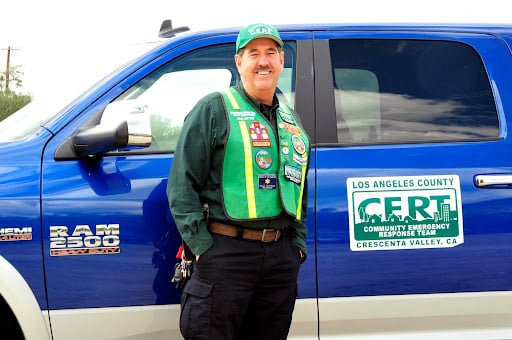
Through his work as an instructor with the Sheriff’s Department, collaborating with Homeland Security and FEMA, Dutton has identified a critical disconnect between what emergency preparedness experts recommend and what disaster survivors actually need. As an instructor for the Community Emergency Response Team (C.E.R.T.) for 25 years, Paul has trained thousands on getting better prepared ahead of time!
The conventional wisdom pushes three-day emergency kits. Government agencies repeat it. Well-meaning organizations echo it. The message is clear and comforting: prepare for three days, and help will arrive.
Dutton calls this what it is: a dangerous myth.
His experience across multiple disasters has taught him that recovery doesn’t follow a neat three-day timeline. The Northridge earthquake proved that power could be out for months. His shelter work showed him that displaced families don’t return to normalcy within 72 hours. The pattern repeats across earthquakes, fires, floods, and wind events.
“We need to stop perpetuating this myth saying the fairy godmother will come down and wave her magic wand, and after three days, everything will go back to normal,” Dutton states firmly. “We know from experience that this recovery will take months, and usually years.”
Building Real Resilience
Through The Emergency Preparedness Network, Dutton works to close this preparation gap. His approach isn’t rooted in fear-mongering or selling unnecessary supplies. It comes from three decades of real-world experience in disaster response and recovery, combined with the perspective of someone who has personally faced the decision of what to grab when leaving home, possibly for the last time.
The solution, according to Dutton, starts with honesty about timelines. Instead of a three-day kit, families need 30-day preparedness plans. This isn’t about stockpiling for doomsday scenarios. It’s about understanding that infrastructure takes time to restore, supply chains need weeks to recover, and displaced families often face extended periods before returning to their homes.
His methodology draws from multiple frameworks—sheriff department protocols, C.E.R.T. curriculum, FEMA guidelines, Red Cross operations, and Homeland Security standards—distilled through the lens of practical application. What works in theory doesn’t always work when your power has been out for a week or when evacuation routes are blocked by fire.
A Mission Born from Experience
Thirty-two years after those seventeen seconds changed his trajectory, Dutton continues his mission with the urgency of someone who knows disasters aren’t questions of if, but when. His volunteer work with sheriff operations keeps him engaged with current emergency response tactics. His shelter operations experience keeps him connected to the human cost of unpreparedness. His role as a father who has evacuated his own family multiple times keeps the mission personal.
The families arriving at shelters with nothing but their keys haunt him still. The injured who couldn’t reach safety quickly enough. The months of recovery that extend far beyond those optimistic three-day predictions. These experiences fuel his determination to change how Americans think about disaster readiness.
Emergency preparedness isn’t about preparing for the worst-case scenario, Dutton argues. It’s about preparing for the most likely scenario: that when disaster strikes, recovery will be measured in weeks and months, not days. That government resources will be stretched thin. That families will need to rely on their own preparation more than they’ve been led to believe!
Through The Emergency Preparedness Network, Dutton works to ensure other families don’t face that moment—standing at their front door, looking back at everything they’ve built, uncertain if they’ll see it again—without having done everything possible to protect themselves and their loved ones, ahead of time!
Seventeen seconds taught him that lesson. Three decades have reinforced it. Now, he’s dedicated to making sure others learn it before their own seventeen seconds arrive.
This article was published on HarcourtHealth