
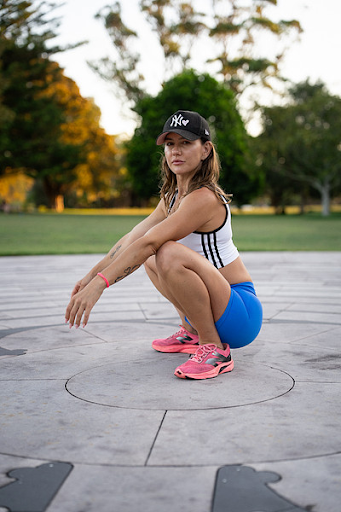
There is a category of movement that the mainstream fitness industry has spent decades treating as dangerous. Deep spinal flexion. Full hip closure under load. End-range rotation with tension. Overhead positions that go past where the shoulder feels comfortable. Hanging from things. Sitting on the floor. Loading the body in directions that aren’t up, down, or directly forward. Most coaches, most programs, and most gym environments have a standing instruction about these positions: don’t go there. They’re risky. They’re extreme. They’re for specialists, not regular people.
Vanja, founder of Moves Method and movement educator to over 180,000 students across 45 countries, trains in them every day. More than that, she builds her entire methodology around them. Her position is that the positions the industry told people to avoid are precisely the ones the body most urgently needs. And the instruction to avoid them is, in her view, one of the most damaging things the fitness industry ever told people to do.
Where the warning came from
The avoid-these-positions doctrine didn’t come from nowhere. It came from a reasonable observation applied unreasonably broadly. Loaded spinal flexion under heavy weight, performed with poor mechanics and insufficient preparation, can cause injury. A deep squat in a body with no hip mobility and no posterior chain strength is a liability. End-range rotation under tension requires a body that has been progressively prepared for it.
The industry’s response to this was to remove the positions from most programs entirely. If the deep squat is risky without preparation, don’t squat deep. If spinal flexion under load can cause disc problems, avoid spinal flexion under load. If end-range rotation is dangerous without the requisite strength, eliminate rotation. It’s clean, defensible, and, Vanja argues, catastrophically counterproductive.
“The industry looked at unprepared bodies getting hurt in difficult positions and decided the positions were the problem. They weren’t. The unpreparedness was the problem. The solution was preparation. Instead, they chose avoidance — and built an entire generation of people who are fragile everywhere the gym didn’t go.”
The result is a population that has been coached away from the very positions their bodies were built to occupy. And the irony, she notes, is that avoidance didn’t make those positions safer. It made them more dangerous. A position the body never trains is a position the body is completely unequipped for the moment life demands it.
What the avoided positions actually are
The positions Vanja trains — and teaches — aren’t exotic. They’re ancestral. They’re the shapes the human body was designed to produce across a lifespan, and that most humans in non-Western, non-sedentary cultures still produce without effort or injury.
The deep squat is one. Full hip closure, heels down, torso upright, hips fully flexed, a position that a significant portion of the global population uses as a default resting posture, and that the majority of Western adults can no longer access at all. Not because it’s dangerous. Because they stopped doing it, and then were told not to go back.
The dead hang is another. Full shoulder suspension, arms overhead, body weight supported through the shoulder girdle in its most extended position. Treated in most gyms as a transitional moment between exercises. In Vanja’s methodology, it’s a primary strength position, trained progressively over years, producing shoulder health outcomes that no rotator cuff isolation exercise ever matched.
Spinal flexion and extension under load. Lateral loading. Rotation under tension. Floor-based movement — crawling, rolling, transitioning between positions at ground level. These are not advanced skills. They are basic human movement vocabulary that the fitness industry has classified as risky and quietly removed from the curriculum.
“These positions aren’t dangerous because they’re extreme. They’re dangerous because people have been told to avoid them for twenty years and now walk into them completely unprepared. The danger was manufactured by the avoidance.”
How preparation changes everything
The distinction Vanja makes is between a position and a prepared body in that position. The deep squat isn’t dangerous for a body that has been progressively loaded through the range. The dead hang isn’t risky for a shoulder that has been built to handle full suspension. Spinal flexion under load isn’t a disc injury waiting to happen in a spine that has been trained to move in that direction with control.
The preparation is everything. And the preparation, in her methodology, is exactly what most programs skip in their haste to avoid the destination.
What that preparation looks like is specific: progressive loading through range, beginning with bodyweight and building over time. Active end-range work, not passive holding. Exposure to the position repeatedly, consistently, with enough load to tell the nervous system the position is familiar rather than threatening. The body adapts to what it’s asked to do. Ask it to be strong in a deep squat and it becomes strong in a deep squat. Ask it to handle full shoulder suspension and it builds the capacity to handle full shoulder suspension.
“Preparation isn’t a warm-up. It’s months of deliberate exposure to the position you’re trying to own. The industry skipped that step and called the destination dangerous. The destination was never the problem.”
What avoiding them actually costs
The practical consequence of training around the avoided positions is a body with significant structural gaps. The hip that has never been loaded in full flexion is a hip that has no strength or stability at the bottom of a squat, which is exactly where it’s most likely to be demanded by a fall, a stumble, or an unrehearsed movement at an awkward angle. The shoulder that has never been trained in full suspension has no capacity in the position it’s most vulnerable, which is overhead and loaded.
These gaps don’t stay theoretical. They become injuries, the kind that happen not in the gym, under controlled conditions, but in ordinary life, in the shapes the gym told people to avoid and life declined to remove from the repertoire. The disc that goes reaching under a bed. The shoulder that tears picking up a heavy bag from an overhead compartment. The hip that locks in a position the body has no training history with.
“The injuries happen in the gaps. Every position the program skipped is a gap. Most people are carrying years of gaps and don’t find out until something falls into one.”
The case for going there
What Vanja is making, ultimately, is a case for full physical literacy. A body that can produce force across its entire range of available motion — not just the comfortable middle, not just the rehearsed patterns, not just the positions the industry decided were safe enough to program — but the full vocabulary of human movement, including the parts that require preparation, patience, and a willingness to train in positions that feel wrong before they feel right.
The deep squat. The dead hang. The loaded rotation. The floor-based movement. The end-range hip work. The spinal articulation under load. These aren’t the advanced curriculum. They’re the foundation — the positions the body was built for and that the fitness industry, in its attempt to make training accessible and defensible, systematically removed from the program.
The clients who come to Moves Method having spent years being coached away from these positions don’t find them dangerous when they’re properly introduced. They find them revelatory. The shoulder that was always managed suddenly has a direction to train toward. The hip that was always worked around suddenly has a range to build into. The body, given access to the positions it was designed to occupy, starts to function like a body that belongs to its owner.
That, in Vanja’s view, is what the avoidance was always costing. Not just range. Not just strength at the edges. The experience of living in a body that has access to itself fully, without gaps, without routes around its own restrictions.
Most coaches told people to avoid those positions. Vanja went there instead. And built a methodology, and a following, around what she found on the other side.